call for visit : +919772732488

15 Died in Nov, JDA Strikes Back Feb: 3 Km Lohamandi Road Cleared of Encroachments
3 months after dumper tragedy killed 15, JDA removes 15-20 ft illegal encroachments on Harmada Lohamandi Road. 12-hour drive, 3 km stretch. Full ground report & FAQ.
Jaipur Dream Homes
2/13/20265 min read
15 Lives, 3 Months, 3 Kilometers: Lohamandi Road Finally Gets Its Revenge on Encroachers
Three months ago, this road turned into a graveyard.
On a chilly November morning in 2025, a speeding dumper truck lost control on the Harmada Lohamandi Road. It did not just crash. It hunted. It ploughed through pedestrians, roadside vendors, and morning walkers with merciless momentum. When the metal monster finally rested, 15 lives lay crushed on the tarmac. Over two dozen others were left battling for breath in ICU wards.
The city mourned. Condolence meetings were held. Flowers were laid. Political statements were issued.
And then, silence.
But silence is not justice. Silence does not widen roads. Silence does not remove the illegal ramps, the encroached parapets, the stolen footpaths that force pedestrians to walk on death row.
On Friday, 6th February 2026, the silence was finally broken.
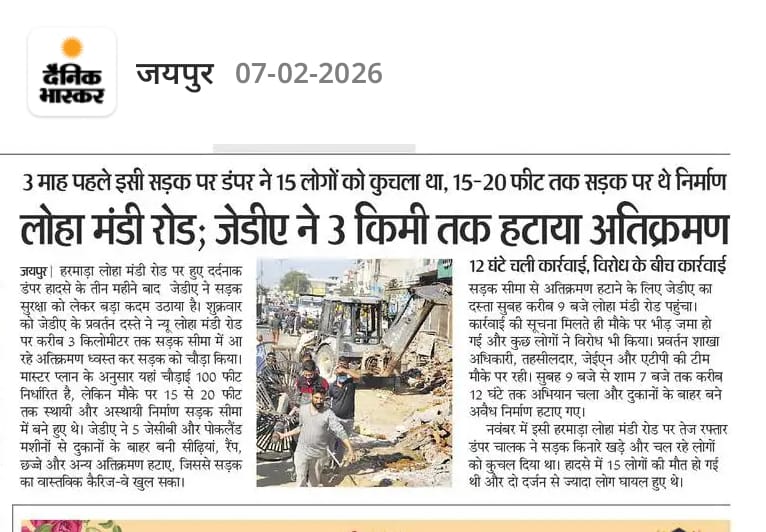
The Jaipur Development Authority (JDA Newly Launched Plots) returned to Lohamandi Road. Not with wreaths and speeches but with Pokland machines, enforcement teams, and a 12-hour demolition drive that tore through three kilometers of illegal encroachment.
This is not just a news report. This is the story of a road that demanded accountability. This is the sound of 15 graves crying for action.
The Reckoning: What Happened on Friday?
At 9:00 AM, the JDA’s enforcement squad, accompanied by Tehsildar officials and Assistant Town Planners (ATP), arrived at the New Lohamandi Road. Their target was unambiguous: every illegal structure that had crept onto the designated road boundary.
For 12 continuous hours until 7:00 PM machines gnawed at concrete that never should have existed.
What was removed?
Sikhiya (Parapets): Elaborate concrete ramps built outside shops to help vehicles jump onto footpaths.
Ramps: Illegal driveways encroaching up to 15–20 feet onto the road.
Chhattis (Canopies): Permanent roof extensions that turned public land into private verandas.
Temporary Shops: Structures that began as "temporary" decades ago and fossilized into permanent hazards.
The Scale:
Stretch Covered: Approximately 3 Kilometers
Duration: 9:00 AM to 7:00 PM (12 Hours)
Resistance: Local opposition and heated arguments, but the drive continued.
This was not a symbolic gesture. This was a surgical strike against the slow, silent theft of public space.
Read Blog :- Kotputli–Kishangarh Greenfield Expressway
The Backstory: A Tragedy That Was Waiting to Happen
Let us be brutally honest here. Nobody was surprised when that dumper killed 15 people.
For years, Harmada Lohamandi Road was a classic case of urban neglect. Footpaths had vanished under shop extensions. The designated carriageway had shrunk from "road" to "lane." Pedestrians mothers with children, elderly men, factory workers were forced to walk on the asphalt, sandwiched between speeding trucks and stationary encroachments.
The November 2025 accident was not an anomaly. It was an inevitability.
A speeding dumper. A narrow corridor. No escape route. Fifteen families received bodies, not breadwinners.
And yet, for three months, the encroachments remained. The ramps stayed. The illegal parapets continued to serve chai and spare parts.
Until Friday.
Read Blog : Goodbye 40-Minute Jams: Jaipur’s Mahal Road Goes Signal-Free in 2026
Why This Drive Matters: Beyond Bricks and Mortar
It is easy to dismiss this as "just another JDA demolition drive." But that would be a disservice to the 15 dead.
This drive is significant for three reasons:
1. It Breaks the Cycle of Impunity
Encroachment in Jaipur is rarely punished. Once a structure stands for a few years, it acquires a strange legitimacy. "But it has been here for 20 years!" is the standard wail. The JDA’s response on Friday was a quiet but firm: Not anymore.
2. It Restores the Road’s Right of Way
A 200-foot notification does not matter if 20 feet are stolen every kilometer. By reclaiming 15–20 feet of width at multiple points, the JDA has effectively increased the road's carrying capacity without laying a single meter of fresh asphalt.
3. It Sends a Signal
The message from the enforcement team was clear: Tragedies will have consequences. If you build on public land, you are not just breaking the law you are endangering lives. And the law will come back. With machines.
The Human Element: What the Media Didn't Show
I want you to imagine something.
At 9:00 AM on Friday, a shopkeeper in Lohamandi unlocked his shutter. He had spent lakhs of rupees constructing a beautiful marble ramp so customers could drive their SUVs right up to his counter. It had been there for years. It felt permanent.
By 11:00 AM, that ramp was gravel.
He argued. He pleaded. He cited political connections. But the Pokland machine didn't recognize connections. It only recognized the road boundary.
Was he a victim? Economically, yes. But morally? No.
Because every day for years, his ramp had pushed a pedestrian six inches closer to oncoming traffic. Every day, some mother walking her child to school had to step off the footpath because the footpath no longer existed.
The victims of November paid for that ramp with their lives. On Friday, the ramp finally paid its dues.
The Road Ahead: What Must Happen Now?
A single demolition drive, however aggressive, does not fix a broken system. If the JDA is serious about preventing another Lohamandi, three things must follow:
1. Sustained Enforcement, Not One-Day Wonders
Encroachers have long memories and short fears. If the next drive happens six months later, the ramps will be back in seven. Regular, unannounced inspections are the only cure.
2. Pedestrian Infrastructure
Clearing the road is half the battle. The JDA must now build proper footpaths, guardrails, and safe crossing zones. Otherwise, we have simply cleared the track for faster trucks.
3. Accountability for Re-Encroachment
There should be criminal consequences for re-encroaching a cleared government land. A fine is just the cost of doing business. A jail term is a deterrent.
Conclusion: The Road Remembers
Roads have memory. They remember the feet that walked them, the wheels that rolled on them, and the blood that soaked them.
The Harmada Lohamandi Road remembers November 2025. It remembers the screams, the sirens, the white sheets. And now, it remembers Friday the day the city finally came back to reclaim what was always public.
Fifteen people never got to see 2026. But because of this drive, the road they died on might finally become safe enough for the living.
That is not justice. Justice would be bringing them back.
But it is accountability. And right now, accountability is the only currency the dead accept.
Frequently Asked Questions (FAQ)
Q1. Where exactly did this anti-encroachment drive take place?
The drive was conducted on the Harmada New Lohamandi Road in Jaipur, covering an approximately 3-kilometer stretch.
Q2. Why was this drive conducted now, three months after the accident?
The drive was a direct administrative follow-up to the November 2025 dumper tragedy that killed 15 people. The accident exposed severe road narrowing due to illegal encroachments, forcing the JDA to act.
Q3. What types of encroachments were removed?
The JDA removed illegal ramps, sikhiya (parapets), chhattis (permanent canopies), and temporary shop extensions that had been built within the designated road boundary, in some cases encroaching 15–20 feet onto the carriageway.
Q4. How long did the operation last?
The enforcement squad worked for 12 hours continuously, starting at 9:00 AM and concluding at 7:00 PM.
Q5. Was there any resistance or opposition?
Yes. Local shopkeepers and residents gathered at the site and attempted to resist the demolition. However, the joint team of JDA enforcement, Tehsildar, and ATP officials continued the operation despite the opposition.
Q6. Will this drive continue on other roads?
While the JDA has not announced an immediate schedule, sources indicate that roads with high pedestrian fatality risks and severe encroachment are under review.
Q7. What about the victims of the November accident?
The families of the 15 deceased and two dozen injured are still awaiting full compensation and legal closure. This drive is seen as a preventive measure, not retroactive justice.
Q8. How can citizens report encroachment in their area?
Citizens can file complaints with the JDA Enforcement Wing through the official JDA portal or by visiting the zone office. Photographic evidence and location details help expedite action.
Q9. Will the encroachments return?
That depends entirely on sustained vigilance. If the JDA follows up with periodic inspections, the road can remain clear. If not, history has shown that encroachments tend to regenerate.
Q10. What should Jaipur learn from this?
That public land belongs to the public. Allowing illegal construction even "temporary" ramps steals space from pedestrians and hands it to private interests. And sometimes, that theft costs lives.
Important Links
Your trusted partner in real estate solutions.
Contact
Reach us
info@jaipurdreamhomes.com
+91-9351185960
© 2024. All rights reserved.
Gulshan Nama
Sandeep Patodiya
Designed & Developed by Gossips Marketing (Digital Marketing Service Provider)