call for visit : +919772732488

Kotputli–Kishangarh Greenfield Expressway: Land Acquisition Begins, 50 Villages in Jaipur District to Be Affected
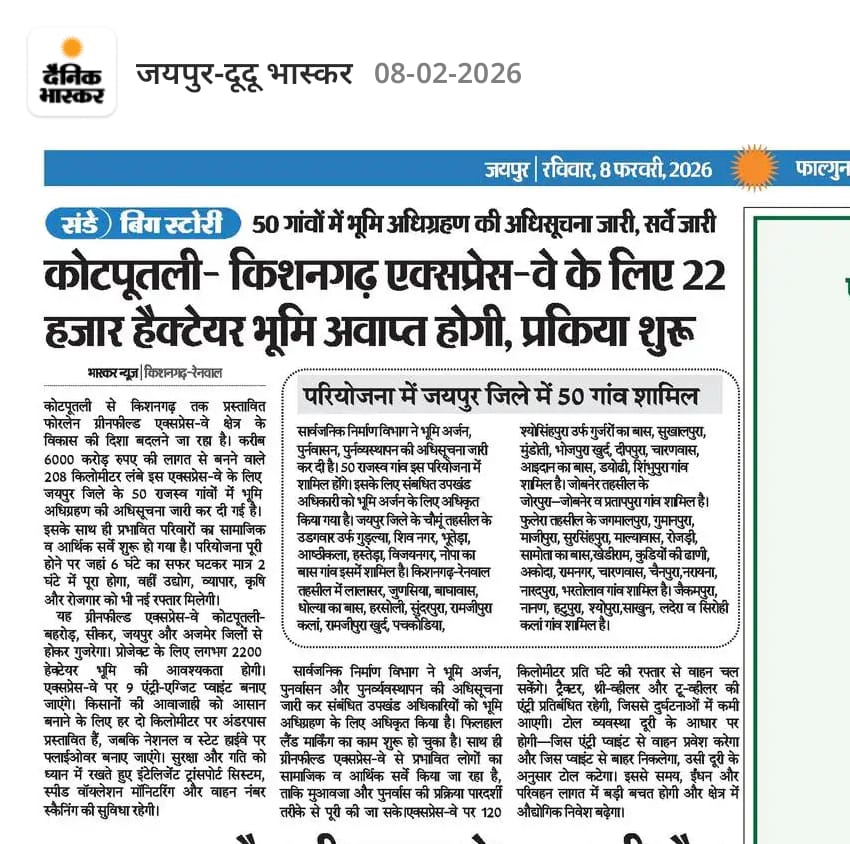
The Rajasthan government has officially initiated the land acquisition process for the Kotputli–Kishangarh Greenfield Expressway, a major infrastructure project expected to transform road connectivity in the state. With this move, nearly 50 villages in Jaipur district and around 22,000 hectares of land are likely to be impacted in different phases.
2/12/20264 min read
Kotputli–Kishangarh Greenfield Expressway: Land Acquisition Begins, 50 Villages in Jaipur District to Be Affected
The Rajasthan government has officially initiated the land (check jda plots in jaipur) acquisition process for the Kotputli–Kishangarh Greenfield Expressway, a major infrastructure project expected to transform road connectivity in the state. With this move, nearly 50 villages in Jaipur district and around 22,000 hectares of land are likely to be impacted in different phases.
This expressway is being developed as a high-speed, modern corridor under the Delhi–Jaipur–Ajmer route, aimed at reducing travel time, improving road safety, and boosting regional economic growth. Once completed, it is expected to become one of Rajasthan’s most important transport links.
What Is the Kotputli–Kishangarh Expressway?
The Kotputli–Kishangarh Expressway is a 4/6-lane greenfield expressway, meaning it will be built on a new alignment rather than expanding an existing highway. The proposed length of the project ranges between 181 and 208 kilometers, with an estimated cost of around ₹6,000 to ₹6,906 crore.
The road will have a width of approximately 100 meters and will be elevated to about 15 feet in several stretches to ensure smooth, uninterrupted, and high-speed movement. The design focuses on modern engineering standards to support long-distance travel with minimal traffic interference.
The expressway will start from Kotputli and pass through Khatu Shyamji, Reengus, Makrana, Nawa, Roopangarh, Kuchaman, and Dudu, finally reaching Kishangarh. In the process, it will directly connect key parts of Jaipur, Sikar, Nagaur, Ajmer, and Alwar districts, strengthening inter-district and inter-state connectivity.
Travel Time Will Drop from 5 Hours to Just 2 Hours
One of the biggest advantages of this expressway is the massive reduction in travel time. Currently, the journey between Delhi–Jaipur–Ajmer can take around 5 hours, depending on traffic conditions. After the expressway becomes operational, the same distance is expected to be covered in approximately 2 hours.
This will make travel not only faster but also far more comfortable, especially for long-distance commuters, tourists, and logistics operators. Reduced congestion on existing highways will also improve safety and driving conditions.
Land Acquisition and Impact on 50 Villages
For the construction of the expressway, the government plans to acquire around 1,679 to 2,200 hectares of land, a significant portion of which is agricultural land.
According to the latest notification, about 50 villages in Jaipur district alone fall within the project alignment. Survey work has already begun, and landowners have started receiving official communication regarding the acquisition process.
Under the Land Acquisition Rules, 2016, the government has formed dedicated committees to:
Hear objections from affected farmers
Ensure transparent valuation
Decide fair compensation based on market rates and land category
For farmers, the situation is mixed. On one hand, there is hope for better compensation and new employment opportunities. On the other, concerns remain about losing ancestral land that has supported families for generations.
Benefits for People and the Local Economy
The expressway is expected to deliver wide-ranging economic benefits. By cutting travel time by up to 3 hours, it will significantly boost logistics, trade, and tourism along the Delhi–Jaipur–Ajmer corridor.
For devotees traveling to Khatu Shyamji, the project is being seen as a major relief, as access to the temple will become much faster and more convenient.
In addition, the high-speed corridor is likely to attract:
Industrial zones
Dry ports and logistics parks
Warehouses
Hotels, dhabas, fuel stations, and service centers
These developments could open up new employment and business opportunities for youth in nearby villages.
The state government considers this project one of the nine proposed greenfield expressways in Rajasthan, aimed at taking the state’s road infrastructure to the next level.
Safety Features and a New Travel Experience
The expressway will have a maximum speed limit of around 120 km/h. For safety reasons, slow and open vehicles such as tractors, two-wheelers, and three-wheelers will not be allowed.
To ensure local connectivity, underpasses and flyovers every 1–2 kilometers are planned, allowing villagers to move safely without interfering with high-speed traffic.
A modern toll system will be implemented where vehicle number plates are scanned, and toll is charged based on distance traveled. This will reduce long queues and eliminate the need for cash payments.
Simply put, this expressway will function like a super-fast elevated route above crowded highways, helping travelers bypass traffic and reach their destination smoothly.
Frequently Asked Questions (FAQ)
Q1. What is the total length and cost of the Kotputli–Kishangarh Expressway?
The expressway will be approximately 181–208 km long, with an estimated cost between ₹6,000 and ₹6,906 crore.
Q2. How many villages in Jaipur district will be affected?
Around 50 villages in Jaipur district will be impacted by the land acquisition process, mostly involving agricultural land.
Q3. How will farmers receive compensation?
Compensation will be decided under the Land Acquisition Rules, 2016, based on market value, land type, and affected structures, with committees formed to address objections.
Q4. Which districts will the expressway pass through?
The route will pass through areas connecting Jaipur, Sikar, Nagaur, Ajmer, and Alwar districts, including Kotputli, Khatu Shyamji, Reengus, Dudu, and Kishangarh.
Q5. What is the biggest benefit for daily travelers?
The biggest benefit is time savings—a journey that currently takes about 5 hours will be reduced to nearly 2 hours, along with improved safety.
Q6. Why are two-wheelers and tractors not allowed?
To maintain high-speed traffic flow and reduce accident risk, slow and open vehicles are restricted on the expressway.
Q7. Will this project create local jobs?
Yes, the development of industrial areas, logistics hubs, hotels, and service centers along the route is expected to generate employment and business opportunities for local residents.
Important Links
Your trusted partner in real estate solutions.
Contact
Reach us
info@jaipurdreamhomes.com
+91-9351185960
© 2024. All rights reserved.
Gulshan Nama
Sandeep Patodiya
Designed & Developed by Gossips Marketing (Digital Marketing Service Provider)