call for visit : +919772732488

Goodbye 40-Minute Jams: Jaipur’s Mahal Road Goes Signal-Free in 2026
JDA confirms U-Shape traffic system on 9 km Mahal Road. 2 lakh commuters to save 20 minutes daily. No right turns, no signals—just smooth driving. Read the full plan.
Jaipur Dream Homes
2/13/20265 min read
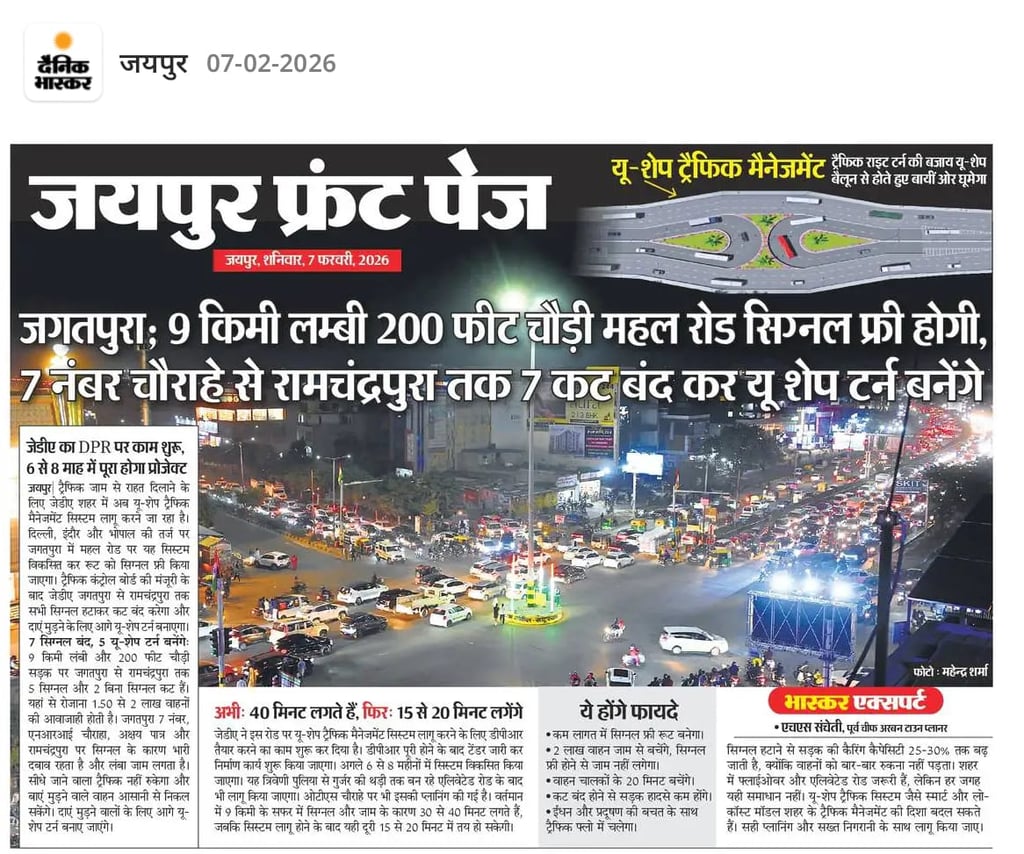
For years, Mahal Road has been Jaipur’s great paradox a 200-foot-wide artery clogged like a narrow lane.
If you have ever been trapped between Jagatpura and Ramchandrapura during the evening rush, you know the feeling. The bumper-to-bumper crawl, the fume-filled air, the clock ticking mercilessly as you sit idle at the 7 Number Chungi signal. It has been a daily test of patience for nearly two lakh commuters.
But patience, it seems, is finally about to pay off.
The Jaipur Development Authority (JDA-Check Plots) has officially unsheathed its most ambitious traffic intervention yet. In a move that borrows a leaf from Delhi, Indore, and Bhopal’s urban playbook, the authority is set to transform the chaotic 9-km Mahal Road stretch into a seamless, signal-free corridor using the U-Shape Traffic Management System.
According to a detailed report published in Jaipur Prots Patra (Saturday, 7th February 2026), the project is no longer a proposal. It is a work in progress. The DPR is underway, the blueprints are being drawn, and within eight months, the Pink City might just witness its most mature traffic overhaul yet.
The Anatomy of the Project: Not Just a Repair, But a Redesign
Let us clear the air immediately. This is not about painting new zebra crossings or installing smarter lights. This is about reimagining how vehicles move.
The Current Reality:
Stretch: Jagatpura (7 No. Chungi) to Ramchandrapura
Length: 9 Kilometers
Width: 200 Feet
Intersections: 5 signalized + 2 unsignalized cuts
Daily Traffic: 1.5 to 2 Lakh vehicles
Peak Travel Time: 40 Minutes
The Proposal:
Signals: All 7 intersections will be dismantled.
Right Turns: Physically closed at junctions.
U-Turn Corridors: Strategically placed ahead of crossings.
Projected Travel Time: 15 to 20 Minutes
Time Saved Per Commuter: 20–25 Minutes per trip
The Philosophy:
Why remove right turns? Because the right turn is the traffic villain. It halts the entire flow for the sake of a few. By pushing the turn 200 meters ahead and wrapping it into a U-shaped ramp, straight-moving traffic never sees red. The result is a road that behaves like a river, not a reservoir.
The Timeline: From Blueprint to Blacktop
The JDA is not letting this gather dust. As per the report, the Detailed Project Report (DPR) is already in motion.
February 2026: DPR initiation and traffic simulation studies.
Next 6–8 Months: DPR finalization, tender issuance, and construction.
Target Date: Operational corridor by October 2026.
The OTS Chowk has also been flagged for similar treatment, indicating that this might just be the pilot for a city-wide signal-free ecosystem.
The Numbers Game: What 25% Extra Capacity Actually Means
When traffic engineers say "carrying capacity will increase by 25–30%," it sounds like jargon. Let us translate that into human language.
Today, if 1,000 vehicles want to pass a point in one hour, 300 of them are stuck waiting. After this project, all 1,000 glide through. There is no stop-start friction. No cascade of brake lights. No honking symphonies.
Figure of Speech: If the old Mahal Road was a stuttering typewriter, the new one will be a smooth fountain pen.
This is not magic. It is geometry. Vehicles in motion occupy less cognitive load on the driver and less physical load on the road.
The Human Impact: Who Wins?
1. The Daily Office Commuter:
Saving 40 minutes daily adds up to 166 hours a year. That is a full week of your life handed back to you.
2. The Emergency Vehicle:
An ambulance stuck at Akshay Patra Chowk today has no workaround. Tomorrow, it flows through.
3. The Environment:
Idling engines are silent killers. Less braking means less particulate matter. This is not just a traffic solution; it is a low-cost climate action.
4. The Economy:
Fuel savings, faster goods movement, and reduced vehicle wear and tear. This corridor quietly boosts productivity without laying a single brick of new tarmac.
The Expert Verdict: Why This Works
“High-cost flyovers are not always the answer. The U-Shape system is smart, low-cost, and scalable.”
Chhaya Sanweti, Former Chief Town Planner
Her words cut to the chase. Jaipur has seen its share of elevated roads and flyovers. They are necessary, but they are expensive and time-consuming. The U-Turn model delivers 70% of the benefit at 20% of the cost. It is urban engineering that respects the taxpayer’s wallet.
The Skeptic’s Corner: Will It Really Work?
Let us address the elephant in the room or rather, the U-turn.
Concern 1: "Won’t U-turns just shift the jam elsewhere?"
Not if designed correctly. The JDA is planning dedicated U-turn lanes with adequate merging length. In cities like Indore, this model has dissolved intersections entirely.
Concern 2: "What about pedestrians?"
This is a valid blind spot. The report does not detail foot overbridges or signal-free pedestrian crossings. For a corridor of this scale, pedestrian infrastructure must walk hand-in-hand with vehicular efficiency.
Concern 3: "What about local shop access?"
Right-turn closures mean some shops may feel "cut off." The solution lies in service lanes and proper signage details the DPR must iron out.
The Bigger Picture: A Template for Jaipur
Mahal Road is not an island. It is a spine. If this model succeeds, it can be replicated on Tonk Road, Agra Road, and Sikar Road. The message from JDA is clear: We cannot build our way out of congestion, but we can design our way out.
This is not concrete-belt worship. It is behavior change at scale.
Conclusion: The Road Ahead
The Mahal Road project is more than a municipal file. It is a statement that Jaipur is ready to graduate from outdated traffic signals to intelligent, human-centric mobility. It acknowledges that the Pink City’s heritage lies not just in its palaces, but also in its ability to adapt.
Yes, the project will face hurdles land acquisition, utility shifting, and the eternal challenge of driver discipline. But the foundation is sound. The intent is honest. And the math is undeniable.
In a city where time is often lost at red lights, 20 minutes saved is not just time. It is freedom.
Jaipur’s Mahal Road Revolution: 9 Km Signal-Free, 20 Minutes Saved, and a U-Turn Towards the Future
Frequently Asked Questions (FAQ)
Q1. What exactly is the U-Shape Traffic Management System?
It is a method of making roads signal-free by removing right turns at intersections and constructing dedicated U-turn points ahead of the crossing. Vehicles going straight never stop, while turning vehicles take a U-turn and merge from the left.
Q2. Which specific stretch of Mahal Road is being covered?
The project covers the 9-km corridor from Jagatpura (7 Number Chungi) to Ramchandrapura.
Q3. How many signals will be removed?
A total of 7 signals/cuts will be dismantled 5 signalized intersections and 2 unsignalized median cuts.
Q4. How long will the project take?
The JDA estimates the system will be operational within 6 to 8 months. Work on the DPR has already commenced.
Q5. How much time will this actually save?
Currently, the stretch takes 40 minutes during peak hours. Post-implementation, it is projected to take 15 to 20 minutes a saving of 20–25 minutes per trip.
Q6. Will this affect pedestrians?
The current report focuses primarily on vehicular traffic. Pedestrian crossings and safety infrastructure will need to be addressed in the final DPR to ensure holistic mobility.
Q7. Is this project expensive?
No. Compared to flyovers or elevated roads, the U-Turn system is low-cost and high-impact. Experts suggest it delivers most benefits of a grade separator at a fraction of the cost.
Q8. Has this been done successfully elsewhere in India?
Yes. Cities like Delhi, Indore, and Bhopal have successfully implemented similar systems on wide arterial roads with significant traffic decongestion results.
Q9. What happens to right-turning traffic?
Right turns at main junctions will be barred. Drivers must proceed to the designated U-turn point, turn around, and approach their desired road from the left feeder lane.
Q10. Will this system be extended to other roads in Jaipur?
The JDA is already planning similar interventions at OTS Chowk. If Mahal Road succeeds, other major corridors are likely to follow.
This article is based on the published report in Jaipur Prots Patra dated 7th February 2026 and subsequent technical analysis. Timelines are subject to administrative approvals and on-ground execution.
Important Links
Your trusted partner in real estate solutions.
Contact
Reach us
info@jaipurdreamhomes.com
+91-9351185960
© 2024. All rights reserved.
Gulshan Nama
Sandeep Patodiya
Designed & Developed by Gossips Marketing (Digital Marketing Service Provider)