call for visit : +919772732488

Rajasthan Cuts Loan Registration Fee to 0.5%: Save ₹20,000 on Home Loan | 106 Model Centers
Big relief! Rajasthan govt slashes registration fee on loans from 1% to 0.5%. Online e-registration launched, 106 model offices to open. See how much you save.
2/17/20266 min read
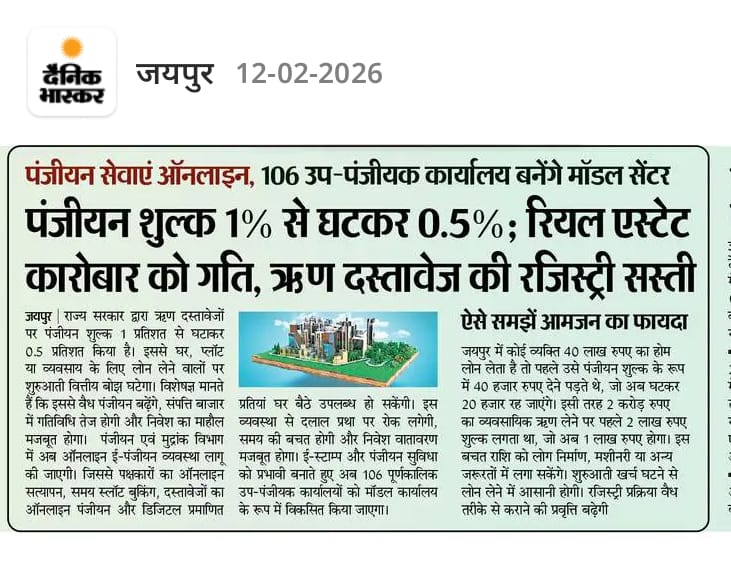
Big Relief for Home Buyers: Rajasthan Slashes Registration Fee to 0.5%, Launches 106 Model Centers for Online Registry
If you are planning to buy a home, take a loan, or register a property in Rajasthan, today is a good day to pop the champagne.
In a move that will put money directly back into the pockets of common citizens, the Rajasthan government has announced a sweeping reform of the registration and stamp duty framework. The changes, reported in Jaipur Patrika/Prots Patra on 12th February 2026, are twofold and both are game-changers.
First, the financial relief: The registration fee on loan documents has been slashed from 1% to 0.5% . This means if you are taking a home loan, you will pay half of what you used to, just to register the papers.
Second, the convenience revolution: The government is rolling out a fully online e-registration system. From verification to appointment booking to document registration to getting certified digital copies everything will happen online, from the comfort of your home.
And to ensure this works seamlessly, 106 sub-registrar offices across the state are being upgraded into Model Offices.
Let us break down what this means for you, your wallet, and the future of real estate in Rajasthan.
Part 1: The Financial Impact – What the 0.5% Fee Cut Means for You
Let us start with the math, because this is where the relief is most tangible.
The Old Rate:
Registration fee on loan documents: 1% of the loan amount
The New Rate:
Registration fee on loan documents: 0.5% of the loan amount
Why does this matter?
When you take a loan to buy a house or a plot, the loan agreement is a legal document that must be registered. That registration attracts a fee. Until now, that fee was 1% a significant upfront cost that added to the already heavy burden of down payments, stamp duty, and legal charges.
Now, that burden is halved.
Let's See It in Real Numbers
Scenario 1: The First-Time Home Buyer
Loan Amount: ₹40 lakh (a typical home loan in Jaipur for a modest 2BHK)
Old Fee (1%): ₹40,000
New Fee (0.5%): ₹20,000
Savings: ₹20,000
Scenario 2: The Small Business Owner
Loan Amount: ₹2 crore (for business expansion, machinery, or commercial property)
Old Fee (1%): ₹2,00,000
New Fee (0.5%): ₹1,00,000
Savings: ₹1,00,000
Scenario 3: The Plot Buyer
Loan Amount: ₹25 lakh (for a residential plot in developing areas)
Old Fee: ₹25,000
New Fee: ₹12,500
Savings: ₹12,500
The Cumulative Effect:
Imagine you are a young professional buying your first home. You have already scraped together ₹8 lakh for the down payment. You are paying ₹3-4 lakh for stamp duty and registration of the sale deed. And then, you are hit with a ₹40,000 fee just to register the loan.
That ₹40,000 could have bought you a fridge, a washing machine, or three EMIs' worth of breathing room.
Now, it stays in your pocket.
Read Blog :- Jaipur Revenue Strike Day 10: 7,000 Registries Stuck, ₹1,200 Crore at Stake
Part 2: The Ripple Effect – More Than Just Savings
This is not just about saving a few thousand rupees. This is about changing behavior.
1. Encouraging Legal Registrations:
When costs are high, people look for shortcuts. Under-the-table deals, unregistered agreements, cash components these thrive when the official route is expensive. By halving the loan registration fee, the government makes the legal path more attractive.
2. Boosting the Real Estate Market:
Real estate is the backbone of the economy. Every home purchase creates demand for cement, steel, labour, furniture, appliances, and loans. When buying becomes cheaper, more people buy. When more people buy, the entire ecosystem thrives.
3. Strengthening the Banking System:
Banks disburse loans only against registered documents. When registration is cheaper and easier, more loans are processed faster. This improves bank liquidity and reduces non-performing assets (NPAs) because the underlying collateral is legally sound.
Part 3: The Digital Leap – 106 Model Centers and Online Registration
The fee cut is the headline, but the digital reform is the foundation.
What is changing?
A. Fully Online E-Registration
The government is implementing a comprehensive online e-registration system. Here is how it will work:
Online Verification: The identity of parties will be verified digitally.
Time-Based Booking: You can book a slot for registration online no more standing in queues since 5 AM.
Online Document Submission: Upload your documents from home.
Digital Certified Copies: After registration, you get digitally certified copies instantly, without visiting the office again.
B. 106 Model Offices
To make this work, 106 full-time sub-registrar offices across Rajasthan are being upgraded into Model Offices. These will have:
High-speed internet and modern IT infrastructure
Trained staff to assist with online processes
Transparent service delivery standards
Comfortable waiting areas for citizens
C. End of the "Dalal" (Broker) Culture
One of the biggest benefits of online registration is the elimination of middlemen. Currently, many citizens rely on touts and brokers to navigate the complex registration process. These middlemen charge hefty fees for simply guiding you through the maze.
With online registration, the maze becomes a straight line. You can do it yourself. And if you need help, the Model Office staff are there free of cost.
Part 4: Who Benefits the Most?
Let us put faces to these policy changes.
The Young Professional: Amit's First Home
Amit, 29, works in a private firm in Jaipur. He has been saving for five years. He finally found a flat in Vaishali Nagar for ₹55 lakh. He is taking a loan of ₹40 lakh.
Old Scenario:
Loan registration fee: ₹40,000
Amit would have had to borrow this from his father or skip buying furniture for six months.
New Scenario:
Loan registration fee: ₹20,000
Amit buys a new bed and a fridge with the savings. His first night in his new home feels complete.
The Senior Citizen: Sushila's Gift Deed
Sushila, 70, wants to transfer her house to her son. The gift deed requires registration. She is not tech-savvy, and the thought of dealing with government offices terrifies her.
Old Scenario:
She would have to hire a broker, pay him ₹5,000, and still spend two days running between offices.
New Scenario:
She visits the Model Office in her zone. A helpful staff member guides her through the online process. She books a slot, verifies her documents, and completes the registration in one visit. No broker. No stress.
The NRI Investor: Rajesh from Dubai
Rajesh, an NRI based in Dubai, wants to invest in a commercial property in Jaipur. He is in town for only three days.
Old Scenario:
Impossible. The registration process would take weeks, and he cannot stay that long.
New Scenario:
He completes the entire process online from his hotel room. Verification happens via video call. Documents are uploaded. The registry is done before his flight back.
Part 5: The Bigger Picture – What This Says About Governance
This reform is significant for reasons beyond the numbers.
1. Citizen-Centric Design:
For decades, government services were designed for the government's convenience. Offices opened at 10 AM and closed at 5 PM. Files moved at their own pace. Citizens were an afterthought.
This reform flips that script. Online registration, time slots, model offices these are designed for the citizen's convenience.
2. Trust Through Transparency:
When processes are opaque, corruption thrives. When everything is online and time-stamped, there is a record. There is accountability. Over time, this builds trust in the system.
3. Formalization of the Economy:
Every property that gets legally registered adds to the formal economy. It creates a paper trail. It enables better taxation. It strengthens the financial system.
Conclusion: A Step in the Right Direction
No single reform can fix everything. There will be teething problems with the online system. Some sub-registrar offices will take time to become "Model Offices." Not every citizen will adapt to digital immediately.
But the direction is clear. And the direction is good.
The government has sent a powerful message: We want to make it easier, not harder, for you to do things legally. We want to reduce your costs, not increase them. We want to serve you, not harass you.
For the home buyer in Jaipur, the small business owner in Jodhpur, the farmer in Bikaner registering his land this is a reason to smile.
Twenty thousand rupees saved here. A hundred thousand there. It adds up. And it adds dignity.
Frequently Asked Questions (FAQ)
Q1. What is the new registration fee on loan documents?
The registration fee has been reduced from 1% to 0.5% of the loan amount.
Q2. When does this new rate apply?
The new rate is effective from the date of the government notification (around 12th February 2026).
Q3. Does this apply to all loans?
This applies to loan documents that require registration, including home loans, plot loans, business loans, and commercial property loans.
Q4. What is an e-registration system?
It is a fully online process where you can verify your identity, book a slot, upload documents, and get digitally certified copies without visiting the registrar's office physically.
Q5. How many Model Offices are being set up?
A total of 106 sub-registrar offices across Rajasthan will be upgraded into Model Offices with modern infrastructure and trained staff.
Q6. Will I still need a broker?
Ideally, no. The online system is designed to be citizen-friendly. The Model Office staff will assist you free of cost. This should significantly reduce dependence on touts and middlemen.
Q7. Can NRIs use the online system?
Yes. The online verification and registration process is particularly beneficial for NRIs who cannot stay in India for extended periods.
Q8. Is stamp duty also reduced?
No. This notification specifically covers the registration fee on loan documents. Stamp duty rates remain unchanged unless separately notified.
Q9. How much can I save?
If you take a ₹40 lakh home loan, you save ₹20,000. If you take a ₹2 crore business loan, you save ₹1,00,000.
Q10. What if I face technical issues with the online system?
You can visit your nearest Model Office for assistance. The government is also expected to set up a helpdesk and helpline for technical support.
Disclaimer: This article is based on the report published in Jaipur Patrika/Prots Patra on 12th February 2026. Readers are advised to verify specific dates and procedures with the official government portal or their sub-registrar office.
Important Links
Your trusted partner in real estate solutions.
Contact
Reach us
info@jaipurdreamhomes.com
+91-9351185960
© 2024. All rights reserved.
Gulshan Nama
Sandeep Patodiya
Designed & Developed by Gossips Marketing (Digital Marketing Service Provider)