call for visit : +919772732488

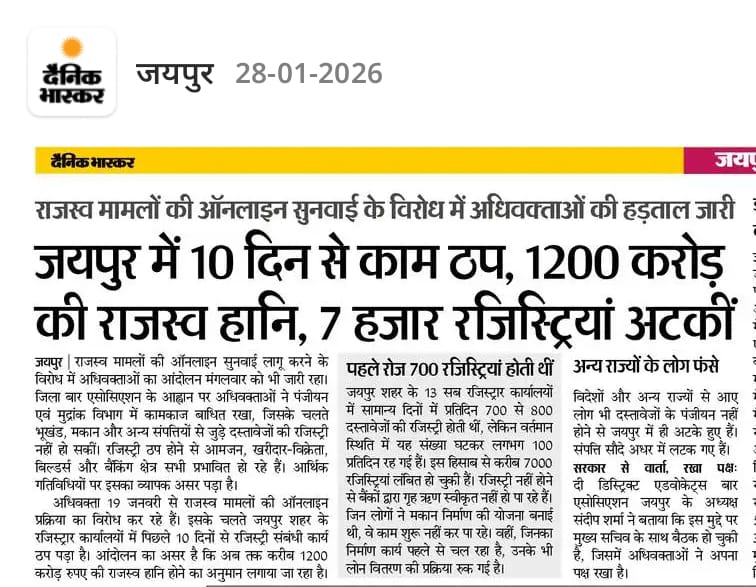
Jaipur Revenue Strike Day 10: 7,000 Registries Stuck, ₹1,200 Crore at Stake
Advocates' strike over online revenue hearings enters Day 10 in Jaipur. 7,000 property registrations pending, ₹1,200 crore stuck. Home buyers, banks, and common citizens hit hard.
2/15/20266 min read
7,000 Registrations Stuck, ₹1,200 Crore at Stake: Jaipur's Revenue Strike Enters Day 10, Common Citizens Pay the Price
For the past ten days, the quiet hum of government offices in Jaipur has been replaced by an eerie silence and the silence is costing the state crores.
Since 18th January 2026, advocates in Jaipur have been on an indefinite strike, protesting the government's move to conduct online hearings of revenue cases. What began as a professional dispute between the bar and the bench has spiraled into a full-blown crisis for the common man.
The numbers are staggering:
7,000 property registrations are stuck in limbo.
An estimated ₹1,200 crore in potential government revenue is hanging in the balance.
Daily registrations have crashed from 700-800 to barely 100.
Home loans are blocked. Property deals are frozen. Families from other states are stranded in Jaipur, waiting for documents that won't come.
This is not just a lawyers' protest. This is a city held hostage by a system that has forgotten who it serves.
The Trigger: Why Are Advocates on Strike?
The dispute centers on a seemingly progressive reform: online hearings of revenue cases.
The government, in its push for digital governance, has mandated that revenue matters—land disputes, title clarifications, inheritance cases—be heard through virtual platforms. The intention is noble: reduce paperwork, increase transparency, and save citizens the trouble of running from pillar to post.
But the advocates see it differently.
The District Advocates Bar Association, Jaipur, led by President Sandeep Sharma, argues that online hearings are being implemented without adequate infrastructure, without proper training, and without addressing concerns about document verification and fraud.
A meeting was held with the former Chief Secretary, but the talks failed to break the deadlock. The strike continues.
And while the lawyers and the government argue, the common citizen is left holding an empty bag.
The Human Cost: Beyond the Headlines
Let us move beyond the jargon of "revenue loss" and "pending registries." Let us talk about people.
The Young Couple and Their Dream Home
Rahul and Priya (names changed) had saved for eight years to book their flat in a new housing project near Jagatpura. They found the perfect 2BHK. The builder was ready. The bank had approved the loan subject to registration.
That was 12 days ago.
Today, the registration is stuck. The bank will not disburse the loan without a registered deed. The builder is threatening to cancel the allotment and forfeit the booking amount. Rahul and Priya are sleeping on a mattress in a rented room, watching their dream crumble, powerless.
Read Blog :- Chaksu's 50-Year Master Plan vs Bhilwara Highway Potholes: Rajasthan's Two Realities
The Outsiders Stranded in Jaipur
Jaipur is not just a city for Rajasthanis. It is a magnet for people from Bihar, UP, MP, and other states—people who come here to work, to invest, to build a future.
Dozens of such families are now stranded. They sold property back home. They booked trains. They arrived in Jaipur with bags and hopes, ready to sign the papers and collect the keys.
Now, they wait. In hotels. In paying guest accommodations. Their money running out. Their patience running thinner.
One gentleman from Bihar told a local newspaper: "I have been here for nine days. My leave is exhausted. My children's school admission depends on this property. I don't care who is right—the government or the lawyers. I just want my papers."
The Senior Citizen Trapped in Paperwork
Seventy-two-year-old Sushila Devi wanted to transfer her house to her son. A simple gift deed. A routine registration.
She took an auto to the tehsil office, her son supporting her by the arm. They reached the gate. And were turned away.
"Strike hai, mata ji. Kal aao."
She has been "kal aao" for ten days now.
The Economic Impact: ₹1,200 Crore and Counting
Let us talk money, because governments understand money.
The Math:
Normal daily registrations: 750 (average)
Average stamp duty and registration fee per property: ₹2-3 lakh (conservative estimate for Jaipur)
Daily revenue loss: ₹15-20 crore
Loss in 10 days: ₹150-200 crore
Projected loss if strike continues: ₹1,200 crore in total stuck value (including circle rate impact, bank loans, and downstream economic activity)
But the real loss is bigger than government coffers.
The Multiplier Effect:
When a property is registered:
The buyer pays stamp duty (to government).
The buyer takes a home loan (bank disburses funds).
The builder gets paid (pays workers, buys materials).
The buyer buys furniture, appliances, paints (local businesses thrive).
When registration stops, the entire chain freezes. Builders don't get paid, so they delay payments to laborers. Laborers don't get paid, so they stop spending. Local markets feel the pinch.
A 10-day strike is an inconvenience. A 30-day strike is an economic wound.
The Legal Tangle: Who Is Right?
As with most disputes, the truth lies somewhere in the middle.
The Government's Case:
Digital transformation is inevitable. Online hearings reduce corruption, eliminate middlemen, and increase efficiency.
Physical hearings cause delays, harassment, and endless paperwork.
The world is moving online; revenue courts cannot be an exception.
The Advocates' Case:
Online hearings require robust infrastructure—high-speed internet, secure servers, trained staff. That infrastructure does not exist in most tehsils.
Document verification in revenue cases is complex. Forgery is a real risk. Physical presence ensures authenticity.
Many litigants, especially in rural areas, are not tech-savvy. Online hearings will exclude them, not empower them.
The implementation is being rushed without consultation with the bar.
The Citizens' Case:
We don't care who wins. Just let us register our property and go home.
The Way Forward: Breaking the Deadlock
Protests and strikes are a legitimate tool of democratic dissent. But when they paralyze essential services for ten days, the tool becomes a weapon—and the common citizen is the casualty.
What Needs to Happen:
1. Immediate Interim Arrangement
Pending a final resolution, the government should set up special physical hearing camps for urgent cases—senior citizens, NRI buyers, and those with court deadlines. This will drain the backlog while talks continue.
2. Hybrid Model
Instead of an all-or-nothing approach, adopt a hybrid model: physical hearings for complex revenue disputes, online for routine matters. Let the user choose.
3. Infrastructure First
Before mandating online hearings, the government must demonstrate that the system works. Conduct pilot projects in select tehsils. Iron out glitches. Train staff. Then scale up.
4. Meaningful Dialogue
The meeting with the former Chief Secretary was a start, but not enough. A permanent committee with representatives from the bar, the revenue department, and the IT department should be formed to monitor implementation and address grievances in real time.
Conclusion: The Sound of Silence
Jaipur is a city that thrives on energy. The clatter of typewriters in revenue offices, the chatter of buyers and sellers outside registry halls, the honking of autos ferrying people to tehsils—these are the sounds of a city alive.
For ten days, that sound has been missing.
In its place, there is silence. The silence of 7,000 files gathering dust. The silence of families waiting by the phone. The silence of a government that cannot govern and a bar that cannot bend.
But silence is not a solution.
The advocates have a point. The government has a point. But the citizen has a life. And that life cannot wait until the lawyers and the bureaucrats decide to stop fighting and start serving.
Let us hope Day 11 brings wisdom. Because Day 10 has already brought enough pain.
Frequently Asked Questions (FAQ)
Q1. Why are advocates on strike in Jaipur?
Advocates are protesting the government's decision to conduct online hearings of revenue cases. They cite lack of infrastructure, risk of fraud, and inadequate consultation with the bar as primary reasons.
Q2. How long has the strike been going on?
The strike entered its 10th day on 28th January 2026.
Q3. How many registrations are stuck?
Approximately 7,000 property registrations are currently pending across Jaipur's 13 sub-revenue offices.
Q4. What is the financial impact?
An estimated ₹1,200 crore worth of property transactions and government revenue is stuck. Daily revenue loss is around ₹15-20 crore.
Q5. How many registrations normally happen per day?
Normally, 700 to 800 documents are registered daily in Jaipur city. That number has now dropped to around 100 per day.
Q6. Who is affected by this strike?
Home buyers, sellers, real estate agents, banks, builders, and common citizens—especially those from other states who are stuck in Jaipur waiting for their documents.
Q7. What about home loans?
Banks will not disburse home loans without a registered sale deed. Many buyers who had loan approvals are now unable to complete their purchases.
Q8. Have there been any talks with the government?
Yes. A meeting was held with the former Chief Secretary, but no resolution was reached. The District Advocates Bar Association, led by President Sandeep Sharma, continues to press its demands.
Q9. Is online hearing a bad idea?
Not inherently. Online hearings can increase efficiency and transparency. However, advocates argue that the infrastructure is not ready, and physical hearings are still necessary for complex revenue cases involving document verification.
Q10. When will the strike end?
As of now, there is no official announcement. Both sides need to return to the negotiating table with a focus on citizen convenience, not just professional pride.
Important Links
Your trusted partner in real estate solutions.
Contact
Reach us
info@jaipurdreamhomes.com
+91-9351185960
© 2024. All rights reserved.
Gulshan Nama
Sandeep Patodiya
Designed & Developed by Gossips Marketing (Digital Marketing Service Provider)