call for visit : +919772732488

12 Crore New City Dwellers in 5 Years: 16th Finance Commission's Roadmap Will Reshape India's Urban Future
16th Finance Commission unveils new urban funding model. Jaipur, Bhopal gain; Patna, Ranchi get more. 12 crore new city dwellers by 2031. State-wise analysis & FAQ.
2/17/20267 min read
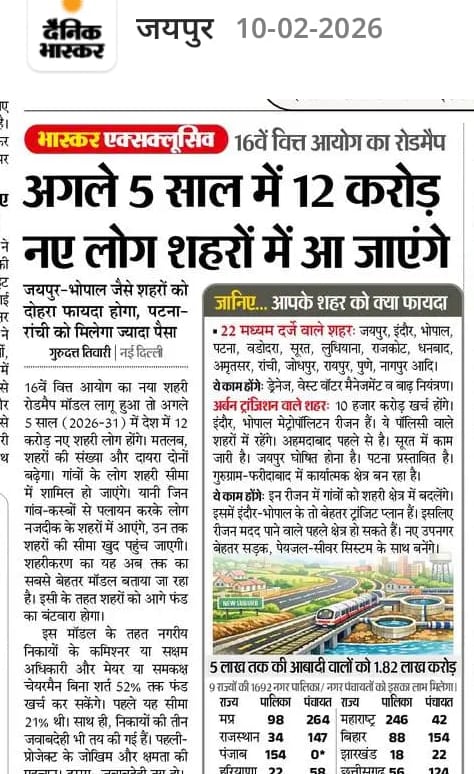
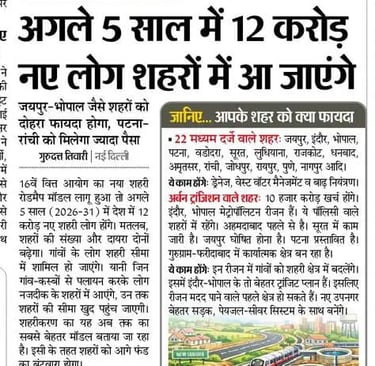
By 2031, India will have 12 crore new faces in its cities.
That is not a prediction. That is a planning assumption baked into the 16th Finance Commission's roadmap for 2026-31.
Every day, thousands of Indians leave their villages some chasing dreams, some fleeing distress, some simply following the tide of history. They land in Jaipur, Bhopal, Patna, Ranchi, and a hundred other cities. They need a place to live. They need water, electricity, sewage, schools, hospitals. They need the city to absorb them.
And the city, in turn, needs money.
The 16th Finance Commission, chaired by former ISRO chief Dr. K. Kasturirangan, has now unveiled a new model for distributing funds to urban local bodies. It is a model that acknowledges a fundamental truth: India's future is urban, and our financing must reflect that.
Let us break down what this means for your city, your state, and your life.
Get :- JDA Plots in Jaipur
The Big Picture: Why This Matters
India is undergoing the largest urban migration in human history. By 2031, the country will have 12 crore additional urban residents equivalent to adding the entire population of Mexico to our cities in just five years.
This is not a gradual shift. It is a tidal wave.
The Challenge:
Cities are already stretched thin. Water runs for two hours a day. Sewage flows in the open. Roads are clogged. Schools are overcrowded.
Urban local bodies (municipal corporations, councils, etc.) are chronically underfunded. They depend on state and central grants for survival.
The 16th Finance Commission's Response:
A new urban roadmap model that will determine how funds are allocated to cities for the next five years (2026-31). The model considers not just current population, but migration patterns, urban sprawl, and the carrying capacity of cities.
Who Wins? The New Geography of Urban Funding
The commission's roadmap reveals a fascinating picture of India's urban future.
The Double Winners: Jaipur and Bhopal
Cities like Jaipur and Bhopal are positioned for a "double benefit." Why?
They are already major urban centers with existing infrastructure and economic activity.
They are migration magnets for surrounding rural areas. People from villages across Rajasthan and Madhya Pradesh are moving to these cities in search of jobs, education, and healthcare.
They have room to grow. Unlike megacities like Mumbai or Delhi, which are bursting at the seams, Jaipur and Bhopal still have peripheral land for expansion.
What this means:
More people means more demand for services. More demand means more funding from the Finance Commission. If managed well, Jaipur and Bhopal could see a virtuous cycle of investment and growth.
Read Blog :- Rajasthan Cuts Loan Registration Fee to 0.5%: Save ₹20,000 on Home Loan | 106 Model Centers
The High-Need States: Patna and Ranchi
States like Bihar and Jharkhand specifically cities like Patna and Ranchi will get "more money" under the new model.
Why? Because they are playing catch-up.
Bihar's urbanization rate has historically been low, but that is changing rapidly. Patna is already bursting with people, and smaller towns like Gaya, Bhagalpur, and Muzaffarpur are seeing unprecedented growth.
The Finance Commission's model recognizes this. It allocates funds based on need, not just current infrastructure. So a city with poor sewage systems and overcrowded schools gets more money to fix those problems.
What These Numbers Reveal:
1. Maharashtra's Urban Might:
Maharashtra has the highest urban population (266 lakh or 2.66 crore) but only 42 urban local bodies. This suggests that Mumbai, Pune, Nagpur, and Nashik are massive cities with huge populations per municipal body. The pressure on infrastructure in these cities is immense.
2. Rajasthan's Dispersed Urbanization:
Rajasthan has 38 lakh urban population spread across 147 urban local bodies. This means many small and medium towns. The challenge here is not just funding big cities like Jaipur, but also ensuring that smaller towns like Chaksu, Sikar, and Chittorgarh get adequate resources.
3. Bihar's Urban Surge:
Bihar has 86 lakh urban population across 104 bodies. Given the state's rapid urbanization, these numbers are likely outdated. The Finance Commission's new model will account for this growth.
4. Punjab's Anomaly:
Punjab shows 153 lakh urban population with only 9 urban local bodies. This seems off and might be a reporting error or a classification issue. It could mean that much of Punjab's "urban" population lives in areas not formally constituted as municipal bodies—a governance challenge in itself.
The Human Story: What 12 Crore New City Dwellers Means
Let us step away from the numbers and talk about people.
Meet Suresh, 24, from a village in Karauli district, Rajasthan.
Six months ago, Suresh worked on his family's farm. The farm barely sustains them. He heard about construction jobs in Jaipur. He packed a bag, took a bus, and arrived in the Pink City with ₹500 in his pocket.
Today, he lives in a jhuggi on the outskirts. He works as a daily wage labourer. He sends money home every month. He dreams of bringing his wife and child to the city someday.
Suresh is one of 12 crore.
Now, imagine 12 crore Sureshes. They all need:
A place to sleep
Water to drink
A toilet that works
A school for their children
A hospital when they fall sick
A bus to get to work
Cities are not ready for them.
Not because cities are heartless, but because cities are broke. Municipal corporations in India have limited revenue sources—property tax, user charges, and grants. They cannot borrow like states. They cannot print money like the Centre.
This is why the Finance Commission's roadmap is a lifeline.
The Policy Shift: From Population to Carrying Capacity
Traditionally, Finance Commissions allocated funds based on population. More people = more money. Simple.
But the 16th Commission is introducing a more sophisticated model. It looks at:
1. Migration Patterns:
Not just who lives in the city today, but who is coming tomorrow. Cities experiencing high in-migration need more investment in housing and basic services.
2. Urban Sprawl:
Indian cities are not just growing vertically; they are spreading horizontally. Peri-urban areas—the fuzzy zone between city and village are seeing explosive growth. These areas often have no municipal services at all. The new model recognizes this.
3. Carrying Capacity:
Some cities are already beyond their carrying capacity. Their water tables are depleted. Their roads are permanently clogged. Their air is unbreathable. The new model may allocate funds specifically for "decongestion" and "rejuvenation" of such cities.
4. Governance Quality:
There is talk of linking funds to governance reforms. Cities that improve tax collection, reduce corruption, and deliver services efficiently could get more money. This is a powerful incentive.
The Winners and Losers: A State-Wise Analysis
Based on the commission's approach, here is a rough sketch of who gains:
Winners:
Bihar, Jharkhand, UP, MP: States with low urbanization but rapid growth will get "catch-up" funds.
Rajasthan, Gujarat: States with a mix of large cities and many small towns will benefit from both urban and peri-urban allocations.
North-Eastern States: Special category status may continue, ensuring adequate funding for small but critical urban centers.
Neutral:
Maharashtra, Tamil Nadu, Karnataka: Already highly urbanized. They will get their share, but the growth in funding may be lower than for catching-up states.
Losers (Potentially):
Delhi, Mumbai, Kolkata: Megacities may find that the new model's focus on "carrying capacity" leads to caps on further investment, pushing funds instead to satellite towns and regional centers.
The Road Ahead: What Must Happen Now
A Finance Commission roadmap is just a map. The actual journey requires action.
For the Government:
Speed Up Implementation: The model is ready. Now, the Ministry of Housing and Urban Affairs must work with states to operationalize it.
Strengthen Urban Local Bodies: Funds are useless if the bodies receiving them are dysfunctional. Capacity building is essential.
Integrate with Other Schemes: The Finance Commission's funds should complement, not replace, existing schemes like AMRUT, Smart Cities Mission, and PMAY-U.
For Cities:
Improve Tax Collection: Own-source revenue is the only sustainable path. Cities must get better at collecting property tax and user charges.
Plan for Migration: Stop pretending migration isn't happening. Plan for it. Build dormitories, affordable housing, and service corridors.
Embrace Technology: GIS mapping, online service delivery, and transparent accounting will help cities make a case for more funds.
For Citizens:
Demand Accountability: Your money, your city. Track what your municipal corporation does with its funds.
Participate in Planning: Many cities have ward committees and citizen forums. Use them.
Welcome the Migrant: The Suresh who came from the village is not a burden. He is the reason your city is alive.
Conclusion: The Future Is Urban. Let's Fund It That Way.
The 16th Finance Commission's roadmap is not a dry policy document. It is a recognition that India has changed.
We are no longer a nation of villages. We are a nation hurtling towards an urban future—whether we are ready or not.
The next five years will see 12 crore people make that journey. They will come to our cities with hope in their hearts and dreams in their eyes. It is our collective responsibility—government, citizens, and institutions—to ensure they find a city that welcomes them, not one that drowns them.
The money is finally being aligned with the reality. Now, the work begins.
Frequently Asked Questions (FAQ)
Q1. What is the 16th Finance Commission?
The Finance Commission is a constitutional body appointed every five years to recommend the distribution of tax revenues between the Centre and states, and among states themselves. The 16th Finance Commission covers the period 2026-31.
Q2. What is the "urban roadmap" mentioned in the news?
It is a new model for allocating funds to urban local bodies (municipalities) that considers migration patterns, urban sprawl, and carrying capacity, not just current population.
Q3. How many new urban dwellers are expected by 2031?
Approximately 12 crore (120 million) additional people will live in India's cities by 2031.
Q4. Which cities benefit the most?
Cities like Jaipur and Bhopal get a "double benefit" as existing urban centers attracting high migration. States like Bihar and Jharkhand (Patna, Ranchi) will get more funds to catch up on infrastructure.
Q5. What does the table in the image show?
It shows state-wise urban population (as per 2011 Census) and the number of urban local bodies. For example, Rajasthan has 38 lakh urban population across 147 bodies, while Maharashtra has 266 lakh urban population across 42 bodies.
Q6. Why does Punjab have only 9 urban bodies for 153 lakh people?
This appears to be an anomaly, possibly due to classification issues or reporting errors. It may indicate that many "urban" areas in Punjab are not formally constituted as municipalities.
Q7. Will my city get more money?
It depends on your state's urbanization rate, migration trends, and the quality of governance. Cities experiencing high growth and those with poor infrastructure are likely to get higher allocations.
Q8. How is this different from previous Finance Commissions?
Previous commissions focused largely on population. The 16th Commission is introducing more nuanced factors like migration, urban sprawl, and carrying capacity.
Q9. What is "carrying capacity"?
It refers to the maximum number of people a city can support sustainably given its infrastructure, water resources, and environmental conditions.
Q10. What can citizens do?
Stay informed, participate in local governance, demand accountability from municipal bodies, and advocate for inclusive planning that welcomes migrants.
Important Links
Your trusted partner in real estate solutions.
Contact
Reach us
info@jaipurdreamhomes.com
+91-9351185960
© 2024. All rights reserved.
Gulshan Nama
Sandeep Patodiya
Designed & Developed by Gossips Marketing (Digital Marketing Service Provider)