call for visit : +919772732488

Jaipur Traffic Makeover: Sikar Road & New Saganer Road to Go Signal-Free
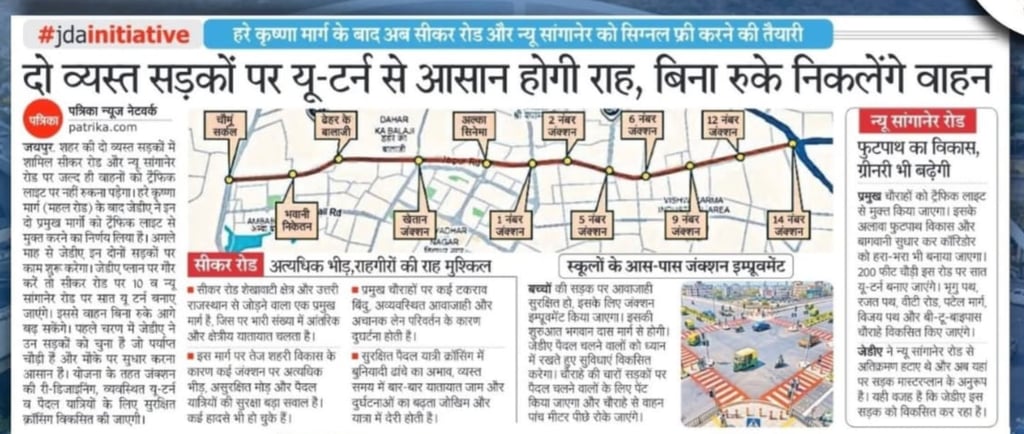
Jaipur Traffic Update! Sikar Road & New Saganer Road to go signal-free with continuous U-turns. Learn how this JDA project will cut travel time, save fuel & ease congestion. Full details & FAQs inside.
3/27/20266 min read
If you live in or travel through Jaipur, you know the drill. You leave home with a smile on your face, only to have it wiped off by the endless wait at traffic signals. The city’s rapid growth has brought with it the universal headache of urban life: congestion.
But there is good news on the horizon for daily commuters. Following the success of the signal-free corridor on Hare Krishna Marg, the Jaipur Development Authority (JDA) is now setting its sights on two of the city’s most critical arteries Sikar Road and New Saganer Road.
According to recent reports, the authorities are preparing to make these bustling stretches signal-free. If you’ve been spending a significant chunk of your life waiting at red lights on your way to VKI Area, Mahal, or beyond, this piece of news is likely music to your ears.
Let’s break down what this plan entails, how it will work, and what it means for you as a driver.
Why Sikar Road and New Saganer Road?
For those unfamiliar, Sikar Road and New Saganer Road are not just ordinary streets; they are lifelines of Jaipur’s transportation network. These roads connect the city to industrial areas, major residential colonies, and outlying districts.
Specifically, Sikar Road is a major corridor leading towards the industrial hubs. It handles massive traffic flow, including heavy vehicles, trucks, and private commuters. Similarly, New Saganer Road has seen a massive surge in traffic due to urban sprawl and the development of new residential schemes.
Currently, these roads are dotted with traffic signals at almost every intersection. While signals are necessary for safety, too many of them on a high-speed corridor break the momentum of traffic, leading to long queues, increased fuel consumption, and frustrating delays.
The Plan: Continuous U-Turns Instead of Red Lights
So, how do you remove signals without causing accidents? The plan is smart and has been tested on other successful corridors in the city.
The JDA has decided to implement the concept of continuous U-turns. Instead of forcing all vehicles to stop at a red light to allow cross-traffic to pass, the infrastructure will be redesigned.
Here is how it will work:
Removal of Traditional Signals: The traditional traffic lights at various intersections will be removed.
Service Roads and Flyovers: Vehicles wanting to turn right or go in the opposite direction will not cut across oncoming traffic. Instead, they will be diverted to service roads that lead to dedicated U-turn loops.
Uninterrupted Flow: Main carriageway traffic will continue to move without stopping. Vehicles wishing to enter side roads or turn around will take the U-turns located at strategic intervals.
This design is similar to the model implemented on Hare Krishna Marg, which has significantly reduced travel time for commuters. The goal is simple: "बिना रुके निकलेंगे वाहन" (Vehicles will pass without stopping).
What This Means for Commuters
If you travel on these roads daily, here is what you can expect once the project is completed in the coming months:
1. Reduced Travel Time
The most obvious benefit is time. Currently, a 10-kilometer stretch on Sikar Road during peak hours can take 30 to 40 minutes. With a signal-free corridor, that time could be cut by half. You won’t have to keep accelerating and braking at every intersection, leading to a smoother driving experience.
2. Fuel Efficiency
Every time you stop at a red light and accelerate again, your car consumes more fuel. By removing the stop-and-go pattern, vehicles will maintain a consistent speed. This not only saves you money on petrol or diesel but also reduces the wear and tear on your vehicle’s brakes and engine.
3. Safety Concerns
There is always a concern when removing traffic signals: "Won't people drive too fast?"
While speed is a factor, signal-free corridors are designed with safety in mind. By segregating the main traffic flow from turning traffic, the chances of "right-angle" collisions (the most dangerous type of crash at intersections) are drastically reduced. However, it will require drivers to be more aware of the U-turn points and maintain lane discipline.
The Phased Approach
The authorities are planning to roll this out in phases. While the exact timeline mentions "next month" for initial groundwork, it is likely a massive infrastructure project that involves re-laying service roads, constructing proper U-turn lanes, and installing proper signages.
The first phase will likely focus on the stretches where traffic density is highest, ensuring that the transition from a signalized intersection to a free-flowing corridor is smooth for the public.
FAQ: Your Questions Answered
To help you understand the nitty-gritty of this development, here are some frequently asked questions:
Q1. Which specific roads are being made signal-free?
A: The Jaipur Development Authority (JDA) has identified Sikar Road and New Saganer Road. These are two of the busiest corridors in Jaipur, connecting the city to industrial and residential zones.
Q2. When will this project start?
A: According to the news summary, preparations are underway, and work is expected to start soon, with the aim of making the roads signal-free starting next month. However, large infrastructure projects often take a few months to fully complete, so commuters should watch for official traffic advisories.
Q3. How will I cross the road or turn if there are no signals?
A: The plan relies on Continuous U-Turns. Instead of stopping at a red light to cross or turn right, you will drive a little further ahead to a dedicated U-turn loop or underpass. These loops allow you to safely change your direction without interrupting the main flow of traffic.
Q4. Will this affect local businesses and side road access?
A: Typically, signal-free corridors include well-developed service roads. Access to shops, offices, and residential areas along the side roads will be maintained via these service roads. You won't lose access; you might just have to drive an extra 200-300 meters to a designated U-turn point to enter the main road on the opposite side.
Q5. Is this the same as the Hare Krishna Marg corridor?
A: Yes, exactly. The JDA previously implemented a similar model on Hare Krishna Marg. That project was widely praised for significantly reducing congestion and travel time. The authority is now replicating that successful model on Sikar Road and New Saganer Road.
Q6. Will it be safe for pedestrians?
A: This is a crucial point. While signal-free corridors are great for vehicular traffic, they can be challenging for pedestrians. The success of this project will depend on the construction of safe pedestrian overpasses (foot overbridges) or subways at strategic points. We will have to wait and see if the JDA includes robust pedestrian infrastructure in the plan.
Q7. What about heavy vehicles like trucks and buses?
A: Since Sikar Road has significant industrial traffic, the design will have to accommodate heavy vehicles. The U-turns need to have a large radius to allow trucks and buses to turn comfortably. If designed well, the signal-free corridor will actually help heavy vehicles clear the area faster, reducing the chain reaction of jams they often cause at signals.
Q8. Will my commute time actually decrease?
A: If executed properly, yes. The logic is simple: if you don't have to stop at 5 or 6 traffic signals, your average speed increases. However, during the initial phase of construction, there might be temporary disruptions. Once the work is completed, commuters should see a drastic reduction in travel time.
Q9. What should I do during the construction phase?
A: It is advisable to plan your travel with a buffer of extra time. Follow the Jaipur Traffic Police social media handles for real-time updates. Drive carefully around construction zones and obey the temporary signage put up by the authorities.
Q10. Will this solve the traffic problem permanently?
A: It is a major step forward. Signal-free corridors help manage through traffic (people going from one end of the city to the other). However, traffic management is an evolving challenge. As the city grows, a combination of signal-free corridors, better public transport, and strict parking regulations is needed for a permanent solution.
Final Thoughts
The decision to free Sikar Road and New Saganer Road from the clutches of traffic signals is a welcome move. It shows that the administration is listening to the frustrations of the public and is willing to invest in infrastructure that prioritizes the smooth flow of vehicles.
For the residents of Jaipur, this means less honking, less pollution from idling engines, and more time to spend with family instead of sitting behind a steering wheel.
As the work begins, we hope the authorities pay attention to the details—proper lighting at U-turns, clear signages, and safe crossings for pedestrians. If done right, Jaipur is set to get two world-class corridors that will define the city’s commute for the next decade.
Important Links
Your trusted partner in real estate solutions.
Contact
Reach us
info@jaipurdreamhomes.com
+91-9351185960
© 2024. All rights reserved.
Gulshan Nama
Sandeep Patodiya
Designed & Developed by Gossips Marketing (Digital Marketing Service Provider)