call for visit : +919772732488

Jaipur Metro Phase 2 Approved: ₹13,037 Crore North-South Corridor, 36 Stations by 2031 | Property in Jaipur Impact
Cabinet approves Jaipur Metro Phase 2 at ₹13,037 crore. 42.8 km North-South corridor with 36 stations connecting Sitapura, Airport, SMS Hospital by Sept 2031. See how property in Jaipur near these stations will appreciate. Full details inside.
4/18/20265 min read
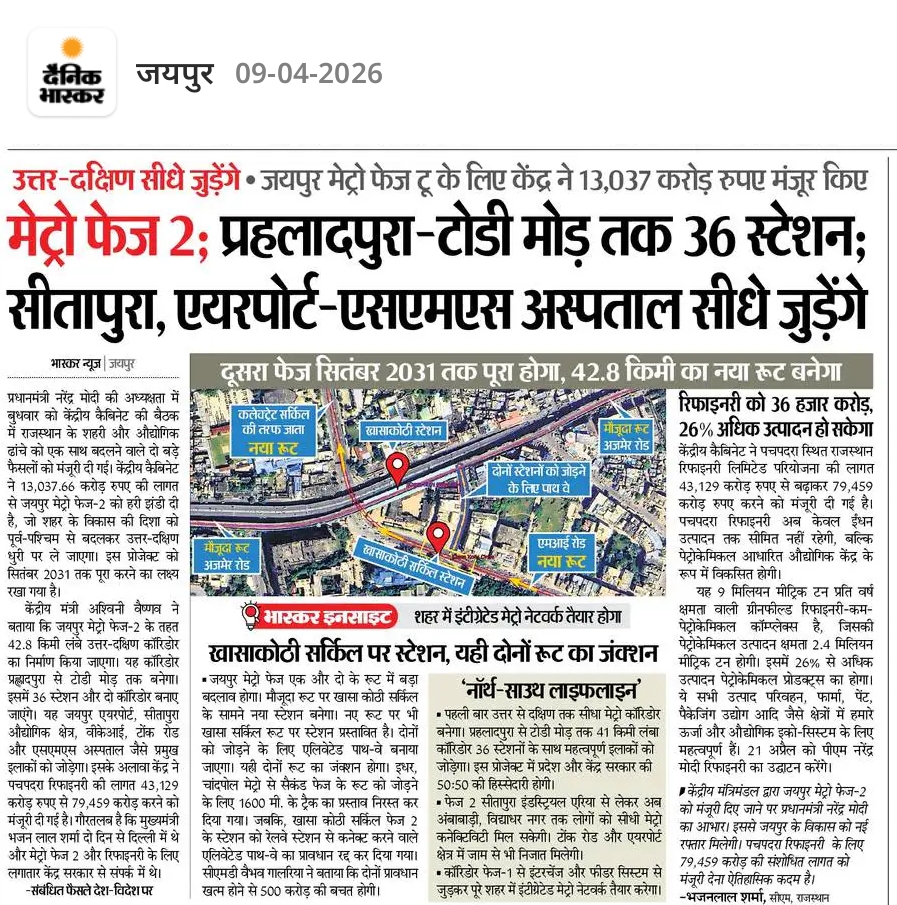
Jaipur Metro Phase 2 Approved: A New North-South Corridor to Redefine City Living & Property in Jaipur
In a landmark decision that is set to reshape the Pink City’s future, the Central Cabinet has given its green signal to the Jaipur Metro Phase 2 project. With a massive budget allocation of ₹13,037 crore, this expansion isn’t just about adding more trains—it’s about changing the entire urban landscape of Jaipur.
For years, Jaipur’s development was linear. But with the new 42.8 km North-South corridor from Pratap Nagar (Prahlaadpura) to Todi Mode, the city is finally getting the spine it deserves. If you live in Jaipur, or are planning to invest here, this news is a game-changer. Let’s break down everything you need to know about this project, its timeline, and what it means for your commute and your wallet.
Buy JDA plots in Jaipur at best price.
The Big Picture: Why Phase 2 is Different
The existing Jaipur Metro (Phase 1) runs on an East-West axis, connecting Mansarovar to Badi Chaupar. While useful, it left large swathes of the city—especially the bustling southern and northern belts—unconnected.
Phase 2 is a complete shift in strategy. The new corridor will run from North to South, connecting the most crowded industrial and residential hubs directly.
Key Highlights of the Approved Project:
Total Length: 42.8 km (Elevated + Underground sections)
Total Stations: 36
Route: Prahladpura (North) to Todi Mode (South)
Target Completion: September 2031
Key Areas Connected: Sitapura Industrial Area, Jaipur Airport, VKI (Vishwakarma Industrial Area), Tonk Road, and SMS Hospital.
This means a student living near Sitapura will soon be able to reach SMS Hospital or the Airport without battling the infamous Tonk Road traffic. For professionals, it means predictability. For the city, it means decongestion.
The "Human Sense" Impact: More Than Just Steel and Concrete
We often talk about infrastructure in numbers, but let's talk about human impact.
Right now, if you work in the VKI or Sitapura industrial hub and live in the northern parts of Jaipur (like Vidhyadhar Nagar or Pratap Nagar), your daily routine is a nightmare. You lose 2-3 hours just sitting in traffic. With Phase 2, that commute drops to roughly 45 minutes.
Moreover, the connection to Jaipur Airport via Metro is a luxury most Tier-2 cities don't have. Once this is live, you can hop on a train near your home and walk straight into the terminal.
The Junction Logic: Khasa Kothi to Become the Hub
A very smart design choice here is the integration with Phase 1. The new plans confirm a station at Khasa Kothi Circle, which will act as a junction. There will be an elevated pathway connecting the old Metro line to the new one. This creates a "plus sign" network across the city, making every corner of Jaipur reachable.
However, note that the older plan for a 1600-meter track via Chandpole has been scrapped. The focus is purely on the Khasa Kothi interchange, which simplifies the network and saves land acquisition costs.
What About the Pachpadra Refinery?
While the Metro takes the spotlight for Jaipur city, the Cabinet also approved a massive revision for the Pachpadra Refinery. The cost has jumped from ₹43,129 crore to ₹79,459 crore.
Why should a Jaipur resident care? Because this refinery is turning into a Petrochemical Hub. With 26% of its output dedicated to petrochemicals (used in paints, pharmaceuticals, and packaging), it will create thousands of indirect jobs in Rajasthan. More jobs in the state mean more people moving to Jaipur, and more people moving to Jaipur means higher demand for property in Jaipur.
The Real Estate Ripple Effect
Here is where we connect the dots for investors and homebuyers. Whenever a Metro route is finalized, land prices within a 500-meter radius of the stations appreciate faster than gold.
Property in Jaipur near the upcoming Phase 2 corridor is about to witness a steep upward trend. Specifically, look at these micro-markets:
Sitapura & VKI: Currently known as industrial zones, they will become prime residential hubs because of the connectivity to the airport and city center.
Tonk Road: Already a commercial spine, the Metro will solve its traffic nightmare, making high-street retail and office spaces more valuable.
Pratap Nagar (Prahlaadpura): The northern terminal. Currently a crowded residential area, the Metro will push its value up significantly as it becomes the gateway to the North.
Ajmer Road & Todi Mode: The southern end will see a boom in plotted developments as the city expands southwards.
Investment Tip: Look for resale flats or under-construction properties within walking distance of the 36 announced stations. The prices haven't skyrocketed yet because the project completes in 2031, but the "announcement effect" usually spikes prices by 15-20% immediately.
Frequently Asked Questions (FAQs)
To make this easier to digest, here are the answers to the most common questions people are asking right now.
1. When will Jaipur Metro Phase 2 start operating?
The government has set a target completion date of September 2031. Construction is expected to begin shortly after tenders are floated in late 2026.
2. How many stations will there be?
There will be a total of 36 stations on the 42.8 km route.
3. Will the Metro go to the Airport?
Yes. This is the biggest win. The new corridor directly connects Jaipur International Airport (Sanganer) to the rest of the city via the North-South corridor.
4. What is the total cost of the project?
The Central Cabinet has approved ₹13,037.66 crore for Jaipur Metro Phase 2.
5. Will it connect to the existing Metro (Phase 1)?
Yes, but indirectly. The interchange point will be at Khasa Kothi Circle. An elevated walkway will connect the new station to the old line. There will be no direct track connectivity from Chandpole as previously planned.
6. How does this affect property in Jaipur?
Immensely. Areas like Sitapura, Tonk Road, and VKI will see a surge in residential and commercial demand. If you are looking to buy property in Jaipur, focus on the northern and southern ends of this new corridor before construction noise begins.
7. Is the Pachpadra Refinery related to Jaipur Metro?
Not directly, but indirectly, yes. The refinery will boost the state's economy (₹79,459 crore investment). A richer economy creates more jobs, which increases housing demand in the capital city, Jaipur.
The Road Ahead (Literally)
While 2031 seems far, infrastructure projects of this scale change the DNA of a city before they even open. By 2028, you will see land prices stabilizing, new high-rises popping up near station sites, and commercial complexes shifting towards the new corridor.
The rejection of the 1600m Chandpole link and the Khasa Kothi pathway shows that the Jaipur Metro Rail Corporation (JMRC) is prioritizing cost-efficiency and speed. They want this done by 2031, and simplifying the junction points is a smart move.
Final Verdict
For the common citizen, this means less honking, cleaner air, and a faster commute. For the investor, it means a clear signal: The North-South axis is the future of Jaipur.
Whether you are looking for a home to settle down or scouting for commercial property in Jaipur, keep your map centered on the 36 stations of Phase 2. The Pink City isn't just growing; it's finally moving in the right direction.
Disclaimer: This article is based on the news summary dated April 9, 2026, and cabinet approvals mentioned therein. Readers are advised to verify official JMRC announcements for exact station locations and timelines before making investment decisions.
Important Links
Your trusted partner in real estate solutions.
Contact
Reach us
info@jaipurdreamhomes.com
+91-9351185960
© 2024. All rights reserved.
Gulshan Nama
Sandeep Patodiya
Designed & Developed by Gossips Marketing (Digital Marketing Service Provider)