call for visit : +919772732488

Jaipur Master Plan 2047: City Limits DOUBLE to 6000 Sq Km | New Areas List
The JDA is set to expand Jaipur by including 679 villages. Check the new map, affected areas like Chaksu & Dudu, and how this will impact property prices.
3/13/20267 min read
Jaipur's Grand Expansion: Master Plan 2047 to Double City Limits – What It Means for You
The Pink City is poised for a monumental transformation. As the current Master Plan 2025 reaches its culmination, the Jaipur Development Authority (JDA) is gearing up for its most ambitious project yet: the Master Plan 2047. This isn't just a routine policy update; it's a visionary blueprint that aims to redraw the map of Jaipur, promising to reshape the lives of millions and alter the region's destiny for the next quarter-century.
If you own property, plan to invest, or simply call Jaipur your home, this is news that demands your attention. We're diving deep into the JDA's expansive new plan, breaking down what this historic move means for the common citizen, the farmer, the investor, and the dreamer.
The 6,000 Sq Km Question: How Big Will Jaipur Get?
For decades, Jaipur has been bursting at its seams. The current Master Plan, implemented in 2011, governs an area of approximately 2,940 to 3,000 square kilometers . However, with the city's population projected to soar to an estimated 10 to 12.5 million (1 crore to 1.25 crore) by 2047, the need for lebensraum (living space) is critical.
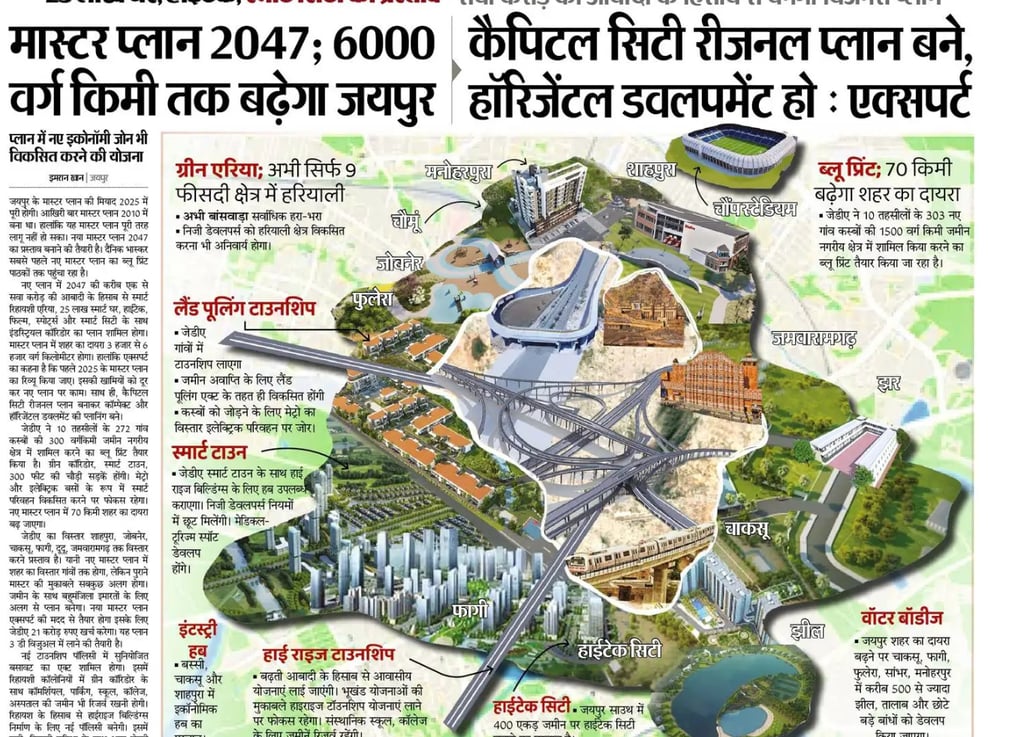
The Master Plan 2047 proposes to double the JDA's jurisdiction by adding another 6,000 square kilometers, bringing the total planned area to a staggering 9,000 square kilometers . This effectively means the city's administrative boundaries will stretch from approximately 40 km to 60 km around the current urban core .
From 272 to 679 Villages: The New Face of Jaipur
Initially, the JDA had prepared a blueprint to include 272 villages. However, after comprehensive studies and a vision for holistic development, the number has swelled. Recent notifications confirm that 679 new villages are now officially part of the JDA's expanded family . This includes areas from key tehsils like Dudu, Phagi, Chaksu, Jobner, Shahpura, and Jamwaramgarh .
This means that if you live in villages along major corridors like Tonk Road (up to Chaksu), Ajmer Road (near Dudu), or Delhi Road (up to Shahpura), you are no longer just a rural resident; you are part of India's next great urban expansion .
A Blueprint for 2047: More Than Just Bigger Boundaries
The Master Plan 2047 isn't just about drawing bigger circles on the map. It’s a sophisticated, tech-driven plan designed to prevent the haphazard growth that plagued previous master plans. The JDA( Check New JDA Plots) is investing approximately ₹21 crore to prepare this plan, leveraging modern technology to create a 3D visualization of the future city .
1. Smarter Zoning: From 18 to 27 Zones
To manage this massive influx of land, the JDA has restructured its administrative framework. The number of zones will increase from 18 to 27 . While the central business districts (Zones 1-8) remain untouched, the new villages are being systematically absorbed into Zones 15 to 25. This granular approach ensures that local characteristics are preserved while allowing for uniform development .
2. High-Tech and Economic Corridors
The plan includes dedicated "Economy Zones" and a focus on creating an "Industrial Corridor." The idea is to make Jaipur not just a residential hub but a self-sustaining economic powerhouse. Concepts like Hi-Tech Cities, Fintech parks, and Sports cities are on the drawing board, designed to generate employment and reduce the need for residents to migrate for work .
3. Green and Sustainable Transport
Forget the narrow, choked lanes of the old city. The new plan emphasizes "Green Corridors" and wide roads, with some arteries planned to be 300 feet wide. There is a strong focus on mass transit, with proposals to expand the metro network and introduce more electric buses to create a seamless and sustainable transport system that connects the new suburbs to the core city .
The Human Element: Opportunities and Anxieties
For the residents of the newly included villages, this is a moment of both opportunity and uncertainty.
The Promise of Development
One of the primary arguments for this expansion is the flow of funds. The Urban Development and Housing (UDH) department has significantly larger budgets compared to rural bodies. By bringing villages under the JDA umbrella, the government aims to accelerate the development of basic infrastructure like electricity, water, and roads .
A JDA official noted, "Incorporating these new areas will facilitate rapid development as UDH gets much more funds allocated compared to rural and panchayati raj departments" . For a farmer in Phagi or a small business owner in Chaksu, this could mean better connectivity and reliable utilities.
The Fear of Urban Sprawl
However, this expansion isn't without its critics. Veteran town planners and retired officials have raised red flags. Chandra Sekhar Parashar, a retired additional chief town planner, argues that this move lacks scientific study and could lead to the squandering of fertile agricultural land .
The biggest concern is management. "JDA cannot manage its present jurisdiction properly. How will it control an area double its present size?" questioned A.K. Gupta, a former chief town planner . Critics suggest that instead of a blanket expansion, the JDA should have focused on developing the ten towns adjacent to Jaipur as independent "Satellite Townships" to decongest the capital.
What This Means for Real Estate and Homebuyers
If there’s one sector that will be electrified by this news, it’s real estate.
1. Land Prices on the Rise
History tells us that when land gets "regularized" or comes under a development authority, prices appreciate. The inclusion of 679 villages means that agricultural land now has the potential to be converted into residential or commercial plots. While the specific land use will be detailed in the final plan, the mere announcement is likely to trigger a surge in land prices in areas like Shahpura, Jobner, and Chaksu.
2. A Shift in Housing Policy
The days of simple plotted developments may be numbered. The new Master Plan emphasizes high-rise buildings and group housing to optimize land use. With a projected need for 2.5 million homes, the focus will be on vertical growth rather than horizontal sprawl. The new township policies will mandate that colonies reserve land for green corridors, commercial complexes, schools, and hospitals, ensuring that new neighborhoods are livable communities from day one .
3. Affordable Housing Push
To cater to the growing population, including the migrating workforce, the plan is expected to push for affordable housing projects. This could be a boon for first-time homebuyers looking for budget-friendly options on the city's outskirts.
The Road Ahead: Challenges to Overcome
While the vision is grand, the path is fraught with challenges.
Implementation: The current Master Plan (2010) was criticized for not being fully implemented. The JDA must ensure that the 2047 plan doesn't suffer the same fate.
Land Acquisition: Acquiring land and compensating farmers fairly will be a politically and socially sensitive task.
Infrastructure Gap: Building roads, sewage systems, and water lines from scratch for 6,000 sq km is a herculean task that requires impeccable execution.
The JDA has already begun the process by sending proposals to tehsildars and is awaiting government approval to issue the final notification . The authority is also undergoing a cadre review, approving 496 new positions to manage the enlarged jurisdiction effectively .
Conclusion: A New Chapter for the Pink City
Jaipur’s Master Plan 2047 is more than just a development document; it’s a statement of intent. It signals that Jaipur is ready to step onto the global stage as a metropolis, ready to embrace its future while managing the delicate balance between urban progress and rural stability.
For the common man, it promises a more organized, well-connected, and prosperous city. For the investor, it opens up a new frontier of opportunities. And for the 679 villages now knocking on the city's doors, it marks the beginning of a new identity.
As we move towards 2025 when the plan is expected to be finalized, one thing is certain: the Jaipur of 2047 will be a city transformed bigger, taller, and bolder than we could have ever imagined.
Frequently Asked Questions (FAQs) About Jaipur Master Plan 2047
1. What is the Jaipur Master Plan 2047?
The Master Plan 2047 is a long-term urban planning document being prepared by the Jaipur Development Authority (JDA) to guide the city's growth until the year 2047. It will replace the current Master Plan 2025 and aims to accommodate the future population and infrastructural needs of the region.
2. How much will Jaipur's area expand under the new plan?
The JDA's jurisdiction is set to expand from the current ~3,000 sq km to approximately 9,000 sq km. This means adding roughly 6,000 sq km of new area, which includes hundreds of villages from surrounding tehsils .
3. How many villages will be included in the new JDA limits?
The number has grown during the planning process. Initially, it was 272 villages, then 633, and the latest reports confirm that 679 villages (including 632 revenue villages) are now part of the expanded JDA region .
4. Which areas will be affected by this expansion?
The expansion will significantly impact areas along major highways. This includes regions near Dudu, Phagi, Chaksu, Jobner, Shahpura, Chomu, and Bassi. Specific roads like Tonk Road (up to Chaksu), Ajmer Road (near Dudu), and Delhi Road (up to Shahpura) will see major development .
5. Will this expansion increase property prices?
Historically, when land comes under a planning authority like the JDA, it becomes more valuable due to the potential for regulated development and better infrastructure. It is highly likely that land prices in the newly added villages will appreciate in the coming years.
6. I own agricultural land in the newly added areas. What happens now?
Your ownership remains, but its land use classification may change. The Master Plan will designate certain areas for residential, commercial, or industrial use. You may have the option to convert your agricultural land for urban use, subject to JDA regulations and fees (like the 90A process) .
7. What are "Green Corridors" and "Hi-Tech Cities" mentioned in the plan?
These are concepts for modern, sustainable urban living. Green Corridors refer to zones with ample greenery, wide roads, and eco-friendly transport. Hi-Tech Cities are planned hubs with advanced infrastructure to attract IT, fintech, and other knowledge-based industries, aiming to create local job opportunities .
8. Is everyone happy with this expansion?
No, there is opposition. Some retired town planners and experts criticize the expansion as being too ambitious and unscientific. They fear it might lead to the loss of fertile farmland and that the JDA lacks the capacity to manage such a large area effectively .
9. When will this new plan be implemented?
The current Master Plan is valid until 2025. The new Master Plan 2047 is currently in its preparation phase. The JDA is finalizing proposals, and after receiving government approval, the plan will be formally notified and implemented, likely starting in 2025 or shortly thereafter .
10. Where can I get more information or raise objections?
Typically, the JDA publishes a draft version of the Master Plan for public viewing and invites suggestions and objections from the public. You will need to keep an eye on the official Jaipur Development Authority (JDA) website and major local newspapers for the public notice regarding the draft plan.
Important Links
Your trusted partner in real estate solutions.
Contact
Reach us
info@jaipurdreamhomes.com
+91-9351185960
© 2024. All rights reserved.
Gulshan Nama
Sandeep Patodiya
Designed & Developed by Gossips Marketing (Digital Marketing Service Provider)