call for visit : +919772732488

Jaipur Beats Indore & Nagpur: Now India’s 3rd Largest Warehousing Hub
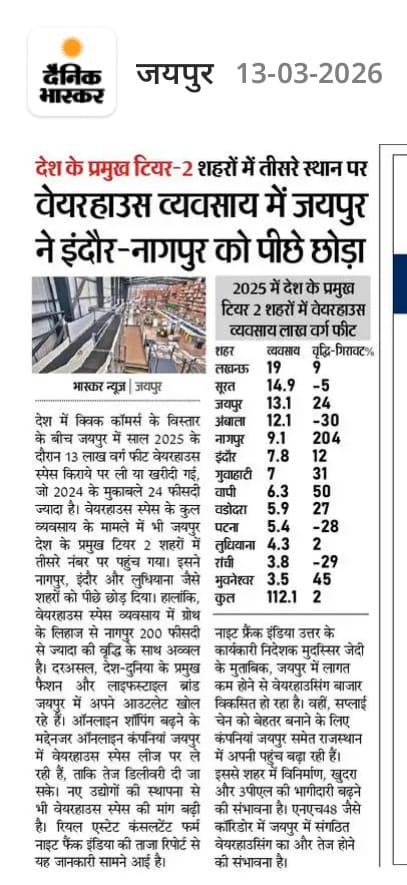
Jaipur warehousing sector grew 24% in 2025, adding 13 lakh sq ft. Discover why the Pink City is outperforming Nagpur & Indore and what it means for real estate investors.
3/23/20266 min read
Jaipur Beats Indore & Nagpur: Now India’s 3rd Largest Warehousing Hub
When we think of Jaipur, the mind instinctively wanders to pink facades, royal heritage, bustling bazaars, and timeless architecture. But beneath this traditional exterior, the Pink City is quietly scripting a new identity—one of logistics, commerce, and industrial might.
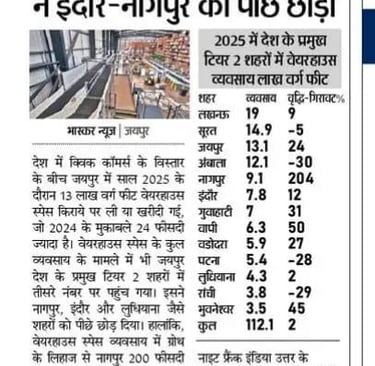
In a remarkable development that signals a shifting economic landscape, Jaipur has surged to become India’s third-largest warehousing hub, leaving behind established competitors like Nagpur, Indore, and Ludhiana. The year 2025 proved to be a watershed moment for the city’s logistics sector, with an unprecedented 13 lakh square feet of warehousing space added—a staggering 24% increase over previous figures.
This isn’t just about boxes in godowns. This is about jobs, investment, infrastructure, and the transformation of Jaipur into a critical node in India’s supply chain network. Let’s unpack what this means for businesses, investors, and the common citizen.
The Numbers That Tell the Story
According to the latest data, Jaipur added 13 lakh square feet of warehousing stock during 2025. To put that in perspective, that’s roughly equivalent to 18 football fields of new storage and distribution space coming online in a single year. This represents a 24% growth, one of the highest year-on-year increases among non-metro cities.
But the real headline is this: Jaipur now ranks third among India’s top warehousing markets, trailing only the traditional giants—Mumbai and Delhi-NCR. In doing so, it has surpassed:
Nagpur (despite Nagpur leading in customer demand growth)
Indore (a long-standing industrial rival)
Ludhiana (the manufacturing heartland of Punjab)
For a city often perceived as a tourism and heritage destination, this is a monumental shift.
Why Jaipur? The Drivers Behind the Boom
So what’s fueling this explosive growth? The reasons are rooted in economics, geography, and changing consumer behavior.
1. Strategic Location
Jaipur sits at a sweet spot. It is part of the Delhi-Mumbai Industrial Corridor (DMIC) , one of India’s most ambitious infrastructure projects. Its proximity to the national capital—just 260 kilometers away—makes it an ideal distribution center for North India. With excellent connectivity via NH-48, the Western Dedicated Freight Corridor, and the upcoming Delhi-Mumbai Expressway, goods can move efficiently to and from Jaipur to markets across the country.
2. Lower Operational Costs
According to Mudassir Zaidi, Executive Director at Knight Frank India, one of the key advantages Jaipur offers is lower costs. Compared to Mumbai or Delhi, land prices, labor costs, and operational overheads are significantly more affordable. This makes Jaipur an attractive destination for businesses looking to set up large-scale distribution centers without bleeding capital.
3. Surge in E-Commerce and Retail
The report highlights a critical trend: major fashion and lifestyle brands are opening outlets in Jaipur, and with the explosion of online shopping, the need for robust warehousing has skyrocketed. Every time a consumer in Rajasthan orders a product online, that item likely passes through a warehouse in Jaipur. As e-commerce penetration deepens into tier-2 and tier-3 cities, the demand for last-mile delivery hubs grows exponentially.
4. Organized Sector Growth
The warehousing sector in Jaipur is increasingly moving toward organized, Grade-A facilities. Gone are the days of haphazard godowns with poor infrastructure. Today, developers are building modern warehouses with high ceilings, fire safety systems, automated inventory management, and excellent connectivity. This professionalization attracts institutional investors and blue-chip tenants.
The Nagpur Paradox: Demand vs. Supply
Interestingly, while Jaipur took the bronze medal in overall business volume, Nagpur emerged as the leader in customer demand growth, with an astonishing over 200% increase. This suggests that while Jaipur has a larger existing warehousing base, Nagpur is witnessing rapid momentum.
What does this mean for Jaipur? It means the competition is fierce. Jaipur cannot afford to rest on its laurels. To maintain its third-place ranking and potentially climb higher, the city must continue to invest in infrastructure, streamline regulatory approvals, and attract more institutional investment.
What This Means for Different Stakeholders
For Real Estate and Landowners
If you own land on the outskirts of Jaipur particularly along Ajmer Road, Tonk Road, or near the Delhi-Mumbai Expressway this news is music to your ears. Warehousing drives land appreciation. As demand for logistics parks grows, so does the value of industrial and commercial land. Investors should keep a close watch on JDA’s upcoming land auctions and policy changes.
For Job Seekers
Warehousing isn’t just about storing goods. It creates a cascade of employment opportunities:
Blue-collar jobs: Warehouse managers, forklift operators, inventory clerks, security personnel.
White-collar jobs: Logistics planners, supply chain analysts, business development roles.
Ancillary services: Transportation, packaging, facility management, and technology services.
With 13 lakh square feet of new space comes hundreds, if not thousands, of new jobs.
For Local Businesses
Small and medium enterprises in Jaipur now have access to world-class logistics infrastructure. Whether you are a manufacturer, a retailer, or an exporter, efficient warehousing reduces your supply chain costs and improves delivery times. This levels the playing field, allowing local businesses to compete with national players.
For the Common Citizen
Better warehousing means faster deliveries, lower prices (due to reduced logistics costs), and more product variety. It also means more tax revenue for the municipal corporation, which can be channeled into public infrastructure like roads, parks, and civic amenities.
Challenges That Need Attention
Despite the rosy picture, the warehousing boom comes with its own set of challenges.
1. Infrastructure Strain
Rapid industrial growth puts pressure on roads, water supply, and power grids. The JDA and Jaipur Municipal Corporation must proactively upgrade infrastructure in industrial corridors to prevent bottlenecks.
2. Regulatory Hurdles
Land conversion, environmental clearances, and building approvals can still be time-consuming. A single-window clearance system for logistics parks could accelerate growth further.
3. Skilled Workforce Gap
While jobs are being created, there is a shortage of trained personnel in warehouse management and logistics. Collaboration between the government, industry, and ITIs (Industrial Training Institutes) is essential to build a skilled workforce.
4. Environmental Concerns
Warehousing complexes, if not planned properly, can lead to urban sprawl and loss of agricultural land. Sustainable planning—including rainwater harvesting, solar power, and green belts must be mandated.
The Road Ahead: What to Expect by 2030
Industry experts predict that Jaipur’s warehousing sector is still in its early growth phase. With the Delhi-Mumbai Expressway expected to be fully operational in the coming years, connectivity will improve even further. Additionally, the proposed Jaipur Ring Road and metro expansion will enhance last-mile connectivity.
Buy JDA Plots in Jaipur at best price.
We can expect:
More Grade-A warehousing parks with integrated facilities like office spaces, worker amenities, and truck terminals.
Increased institutional investment from global pension funds, private equity firms, and real estate investment trusts (REITs).
Technology adoption, including warehouse automation, AI-driven inventory management, and IoT-enabled tracking.
Expansion beyond Jaipur, with satellite logistics hubs in nearby towns like Shahpura, Chaksu, and Bassi.
Conclusion: A New Identity for the Pink City
Jaipur’s ascent to become India’s third-largest warehousing hub is more than just a statistic. It is a testament to the city’s adaptability, strategic importance, and economic potential. While the pink facades and royal forts will always define Jaipur’s soul, its future is being built in sprawling logistics parks, humming with activity, connecting Rajasthan to the rest of the world.
For investors, this is the time to look beyond residential real estate and explore industrial and logistics assets. For job seekers, it’s an opportunity to be part of a booming sector. And for policymakers, it’s a call to build infrastructure that matches ambition.
Jaipur has proven it can beat Indore and Nagpur. The question now is: can it challenge the top two? If current momentum continues, the Pink City might just find itself in the winner’s circle sooner than we think.
Frequently Asked Questions (FAQs)
1. What is the current ranking of Jaipur in India’s warehousing sector?
As of 2025, Jaipur is the third-largest warehousing hub in India, behind only Mumbai and Delhi-NCR. It has surpassed cities like Nagpur, Indore, and Ludhiana.
2. How much warehousing space was added in Jaipur in 2025?
Jaipur added 13 lakh square feet of new warehousing space during 2025, representing a 24% growth compared to previous periods.
3. Why is Jaipur becoming a warehousing hub?
Key reasons include:
Strategic location on the Delhi-Mumbai Industrial Corridor
Lower land and operational costs compared to metro cities
Growing e-commerce and retail demand
Excellent road connectivity via NH-48 and expressways
4. Which cities did Jaipur overtake in warehousing business?
Jaipur overtook Nagpur, Indore, and Ludhiana to secure the third position in overall warehousing business volume.
5. What is the difference between Jaipur and Nagpur in this sector?
While Jaipur ranks third in total business volume, Nagpur leads in customer demand growth, recording over 200% growth. This indicates that both cities are strong competitors with different strengths.
6. How does this benefit real estate investors?
Warehousing growth drives demand for industrial land, leading to appreciation in property values. Areas along key corridors like Ajmer Road, Tonk Road, and near the Delhi-Mumbai Expressway are particularly attractive for investment.
7. What types of jobs are being created?
The warehousing boom creates jobs in:
Warehouse management and operations
Logistics and supply chain planning
Transportation and fleet management
Technology and automation
Security and facility management
8. What challenges does Jaipur face in sustaining this growth?
Key challenges include:
Upgrading road and utility infrastructure
Streamlining regulatory approvals
Developing a skilled workforce
Balancing industrial growth with environmental sustainability
9. Are there any government initiatives supporting this growth?
Yes. The Delhi-Mumbai Industrial Corridor (DMIC) , Western Dedicated Freight Corridor, and state-level industrial policies are actively promoting logistics infrastructure development in Jaipur.
10. What is the future outlook for Jaipur’s warehousing sector?
The outlook is very positive. With major infrastructure projects coming online and continued investment from institutional players, Jaipur is expected to further consolidate its position as a top-tier logistics hub over the next decade.
Important Links
Your trusted partner in real estate solutions.
Contact
Reach us
info@jaipurdreamhomes.com
+91-9351185960
© 2024. All rights reserved.
Gulshan Nama
Sandeep Patodiya
Designed & Developed by Gossips Marketing (Digital Marketing Service Provider)