call for visit : +919772732488

Goodbye Traffic Jams: Jaipur to Ajmer in Just 1 Hour – Highway Upgrade Details Inside
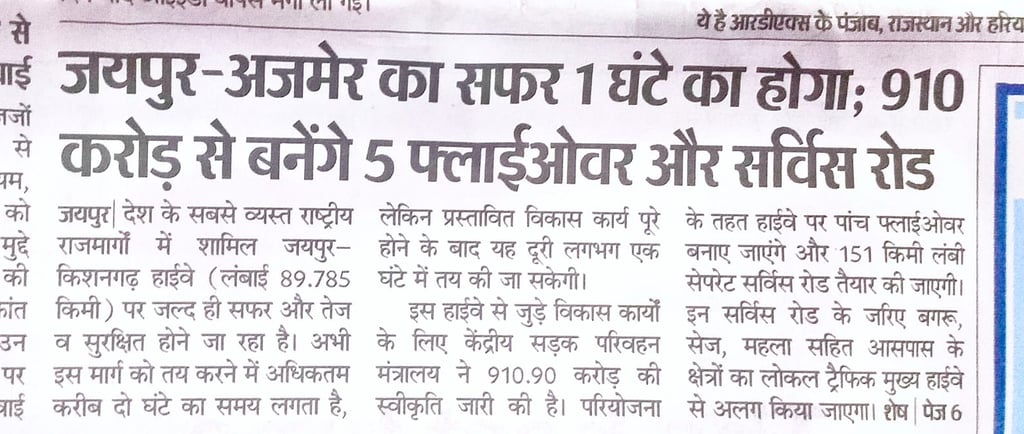
Jaipur to Ajmer in just 1 hour? Yes! ₹910 Cr highway upgrade with 5 flyovers & service roads approved. Check project details & completion date.
3/17/20265 min read
If you have ever driven from Jaipur to Ajmer or Kishangarh, you know the drill. You plan a quick getaway to Pushkar or a business trip to the marble market, but instead of a smooth cruise, you end up spending over two hours navigating through honking trucks, chaotic crossings, and bottleneck traffic jams. For years, NH-48 has been a necessary evil for commuters in Rajasthan vital but incredibly frustrating.
However, there is fantastic news for the millions of people who travel this route. The days of the "two-hour slog" are officially numbered. The central government has greenlit a massive upgrade for the Jaipur-Kishangarh highway that promises to cut the travel time down to just one hour.
Let’s break down what this ₹910 crore project means for you, the traffic situation in the region, and the exciting developments that are finally turning this dream into a reality.
The Big Picture: A 90-Kilometer Lifeline Gets a Makeover
The project targets the Jaipur–Kishangarh section of NH-48, spanning approximately 89.785 km . This isn't just a quick patch-up job; it is a comprehensive overhaul designed to transform this congested corridor into a world-class, six-lane, semi-access-controlled highway .
According to the Ministry of Road Transport and Highways, the project received approval in February 2026, and with nine bids already received from developers, the work is expected to be awarded shortly . The best part? The entire project will be executed without acquiring any new land, which means no lengthy legal disputes and a faster implementation timeline .
What Exactly Is Being Built?
To understand how we will hit that 60-minute mark, we need to look at the engineering marvels planned for the route. The National Highways Authority of India (NHAI) isn't just widening the road; they are re-engineering the driving experience.
1. Five New Flyovers
The image summary mentions five flyovers, but the comprehensive plan is even more ambitious. While specific phases include multiple structures, the core idea is to eliminate conflict points. Major junctions that currently force vehicles to stop will become seamless flyovers, allowing high-speed traffic to flow continuously . Key crossings like Bandersindhri, Mahla, and Sawarda are among those targeted for these upgrades .
2. 151 km of Service Roads
This is a game-changer. The plan includes developing 151 km of separate service roads (also known as slip roads) . These roads run parallel to the main highway and will absorb all the "local" traffic.
For Local Residents: If you live in areas like Bagru, SEZ, or Mahla, you will no longer have to merge onto the high-speed highway just to go a kilometer down the road. You will have a dedicated, safe lane for short distances .
For Highway Commuters: With local traffic, tractors, and two-wheelers moved to service lanes, the main carriageway will be free for fast, uninterrupted movement.
3. Vehicular Underpasses (VUPs)
In addition to flyovers, VUPs will be constructed at major junctions to further streamline traffic and enhance safety .
The Marble Market and the Chaiwala’s Dream
There is a human angle to this development that numbers don't capture. A recent travelogue highlighted the struggles of the route scores of marble trucks from Kishangarh (one of India's largest marble markets) competing for space with cars and local commuters . The article recalled a chaiwala near Sawarda warning travelers to "drive safely" because the road was always dusty and dirty.
This upgrade is for that chaiwala too. By segregating the goods traffic and providing smooth service roads, local businesses along the highway won't be cut off from their customers; instead, they will become safer and more accessible .
Check the latest JDA Plots in Jaipur
Timeline and Current Status
So, when can we actually drive on this dream road?
Bidding: NHAI has already received nine bids for the project in March 2026 .
Award: The project is scheduled to be awarded within the current financial year .
Completion: If past estimates are any indicator, work is likely to begin soon, with hopes that by the end of 2026 or early 2027, the commuters will be cruising down the upgraded highway .
Beyond the Highway: A Boon for Real Estate and Economy
Whenever infrastructure improves, real estate follows. Ajmer Road is already emerging as a prime residential locality in Jaipur, and this project will only accelerate that trend .
Why Ajmer Road is Becoming a Hot Property:
Seamless Connectivity: The road provides direct access to the Jaipur International Airport and is well-linked to the city's metro expansion plans .
Social Infrastructure: The corridor is already home to top-tier educational institutions (DPS, St. Xavier's, Manipal University) and multi-specialty hospitals (Narayana, EHCC) .
Commercial Growth: With the new bus stand at Hirapura diverting long-route buses away from the city center and the highway upgrade easing logistics, the area is poised for significant commercial growth .
The "one-hour commute" means that living further out on Ajmer Road while working in Jaipur city becomes not just feasible, but comfortable.
Conclusion
The upgrade of the Jaipur-Kishangarh highway is more than just a road construction project; it is an economic catalyst and a quality-of-life enhancer. Whether you are a daily commuter, a student traveling to college, a patient needing emergency care, or a businessman transporting goods, this ₹910 crore investment is set to save you time, fuel, and frustration.
The next time you plan a trip to Ajmer to visit the Dargah or to Pushkar for the fair, get ready to set your GPS for just 60 minutes. The open road is calling.
Frequently Asked Questions (FAQ)
Here are some common questions regarding the Jaipur-Ajmer Highway upgrade, answered based on the latest project details.
Q1. How much will the travel time reduce after the project is complete?
Currently, the journey between Jaipur and Kishangarh (and onward to Ajmer) takes about two hours due to congestion. After the completion of the flyovers and service roads, the travel time will be reduced to approximately one hour .
Q2. What is the total cost of this highway project?
The central government has approved ₹910.90 crore for this specific phase of development on the Jaipur-Kishangarh stretch .
Q3. Will there be new flyovers built?
Yes. The plan includes constructing multiple flyovers and Vehicular Underpasses (VUPs) at major junctions. Key locations identified for such structures in various phases include Bagru, Mahla, Sawarda, Narsinghpura, and Gadota to eliminate traffic signals and bottlenecks on the main highway .
Q4. What are service roads, and why are they needed?
Service roads (or slip roads) are smaller lanes running parallel to the main highway. The project includes building 151 km of these roads. They are designed to segregate local traffic (like two-wheelers, tractors, and residents traveling short distances) from the high-speed long-distance traffic on the main carriageway, reducing accidents and congestion .
Q5. Will this project require the government to acquire my land?
No. The highway ministry has stressed that this project will be implemented without any additional land acquisition. The development will occur within the existing right of way, which significantly speeds up the process and avoids legal hurdles .
Q6. When will the construction work start?
The project was approved in February 2026. By March 2026, NHAI had already received nine bids from companies wanting to build it. The contract is expected to be awarded very soon, with construction likely to begin shortly after .
Q7. Is Ajmer Road a good place to invest in property now?
Yes. Real estate experts suggest that Ajmer Road is becoming a prime destination due to the upcoming infrastructure upgrades. With excellent connectivity to the airport, schools, and hospitals, and now the promise of a traffic-free commute, it is considered a high-growth area for both residential and commercial investment
Important Links
Your trusted partner in real estate solutions.
Contact
Reach us
info@jaipurdreamhomes.com
+91-9351185960
© 2024. All rights reserved.
Gulshan Nama
Sandeep Patodiya
Designed & Developed by Gossips Marketing (Digital Marketing Service Provider)