call for visit : +919772732488

Better to Abolish RERA": Supreme Court Slams Pro-Builder Stance, Homebuyers "Disgusted"
Supreme Court says RERA helps defaulting builders, not homebuyers. CJI calls authorities "rehab centres" for bureaucrats. 92% complaints stuck. Full analysis & FAQ.
2/14/20267 min read
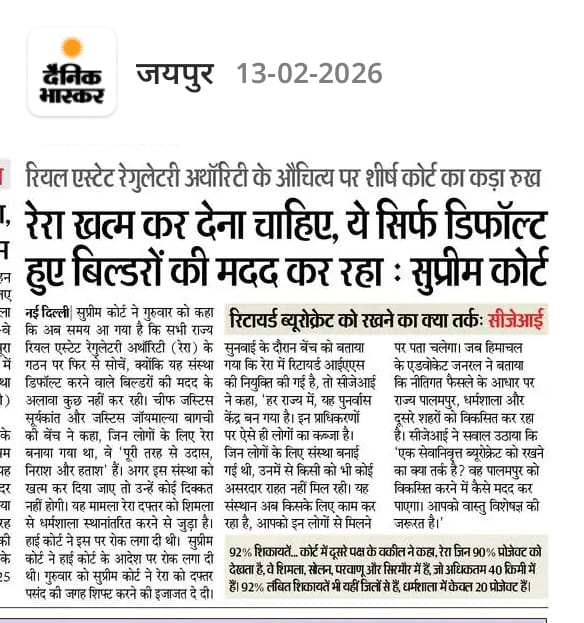
Better to Abolish RERA": Supreme Court's Stinging Indictment Leaves Homebuyers Asking Who Is Protecting Us?
For nine years, it stood as a beacon of hope a regulatory shield meant to protect the common man from the whims of errant builders.
The Real Estate (Regulatory Authority) Act, 2016, was supposed to be the homebuyer's guardian angel. It promised transparency, accountability, and timely justice. It mandated that 70% of buyer funds stay in escrow. It demanded quarterly project updates. It gave the common man a forum to fight back against deep-pocketed developers.
On Friday, 13th February 2026, that hope lay shattered in the Supreme Court of India.
A bench comprising Chief Justice of India Surya Kant and Justice Joymalya Bagchi did not just criticize RERA they eviscerated it. They questioned its very reason for existence. They looked at the institution built to protect millions of middle-class dreams and declared it a failure.
"The people for whom this institution was created are completely depressed, disgusted, and disappointed, " the CJI observed. "Except facilitating builders in default, it is not doing anything else. Better to just abolish this institution. "
Let that sink in.
The highest court of the land, the very pillar of Indian justice, is suggesting that a statutory body has become so ineffective, so captured by the interests it was meant to regulate, that abolition might be preferable to its current state.
This is not just a news story. This is a requiem for a promise broken.
The Context: A Himachal Pradesh Shifting Story That Opened a National Wound
The trigger for this judicial firestorm was, on the surface, administrative. The Himachal Pradesh government wanted to shift the state RERA office from Shimla to Dharamshala . The High Court had stayed this move, arguing it would inconvenience stakeholders.
When the matter reached the Supreme Court, the bench allowed the shift . But then, they looked deeper. They looked at what the RERA office actually does, regardless of where it sits.
The numbers presented in court were damning:
92% of complaints pending before the HP RERA are from districts within a 40 km radius of Shimla Shimla, Solan, Parwanoo, and Sirmaur .
Only 20 projects exist in Dharamshala, the proposed new location .
In plain language: You are moving the court away from the people who need it most.
But the Chief Justice didn't stop at geography. He went to the heart of the matter: Who runs RERA(Check RERA Registered Plots)?
The "Retired Bureaucrat" Problem: A Rehabilitation Centre, Not a Regulatory Authority
When the court was informed that a retired IAS officer had been appointed to RERA, CJI Surya Kant did not mince words.
"In every state, it has become a rehabilitation centre. These authorities are all occupied by these persons, " he remarked .
This is the quiet scandal that homebuyers have whispered about for years. RERA bodies across India have become post-retirement sinecures for bureaucrats. Well-meaning administrators, perhaps. But real estate experts? Hardly.
The CJI posed the question that every frustrated homebuyer wishes they could shout:
"What is the logic of having a retired bureaucrat? How will he be able to help in developing Palampur? You need to avail services of some architect who is environment friendly, who knows the area. Only those persons will help " .
This is not ageism. This is a critique of expertise. You wouldn't put a retired naval admiral in charge of a cancer hospital. Why put a generalist administrator in charge of a specialized real estate tribunal?
The result is exactly what we have: an authority that processes paperwork but does not deliver justice .
The Homebuyer's Lament: Depressed, Disgusted, Disappointed
The CJI used three words to describe the Indian homebuyer: depressed, disgusted, and disappointed .
Let us unpack what that actually means.
Depressed because they have poured their life savings often 30 to 40 years of EMI payments into a home that remains a skeleton of concrete and steel. In India, real estate constitutes over 77% of an average household's assets . When a project stalls, it is not just an investment lost; it is a life's work erased.
Disgusted because they see builders openly flout the law. They see funds diverted from escrow accounts. They see project plans changed without consent. And when they complain to RERA, they see delays, bureaucratic indifference, and orders that exist only on paper.
Disappointed because the very institution built to save them has become a revolving door for the builders it was meant to police.
As activist Abhay Upadhyay of the Forum For People's Collective Efforts (FPCE) recently pointed out, the RERA registration number has not become a symbol of trust unlike the FSSAI stamp on food products . "Builders are brazenly exploiting homebuyers delaying projects, misappropriating funds, and violating agreements right under the nose of RERA authorities," he said .
The Enforcement Void: When Orders Are Just Expensive Paper
Here is the cruelest irony of RERA: even when a homebuyer wins, they often lose.
RERA can pass an order directing a builder to refund money or pay compensation. But enforcement is handed over to state revenue departments, which are overburdened, understaffed, and untrained in real estate complexities . Recovery certificates gather dust. Builders ignore directions with impunity.
Balvinder Kumar, a former member of UP RERA, admitted the painful truth: the authority has "no control over defiant builders" .
The Supreme Court itself noted in the Experion Developers case (2022) that unless RERA orders are treated with the seriousness of civil court decrees, mere issuance of certificates achieves nothing .
Think about that. You fight for years, you spend money on lawyers, you finally get a judgment in your favor and it becomes a piece of paper that a builder can use to wipe his car windshield.
Is it any wonder the CJI suggested abolition?
The Other Side: Has RERA Done Nothing At All?
To be fair, some legal experts argue that RERA is not a complete failure . They point to the 70:30 escrow rule as a genuine reform. Before RERA, builders could use money from Booking for Project A to finish Project B, leaving buyers in the lurch. Now, at least on paper, funds are ring-fenced.
Transparency has improved. Project updates are online. Buyers can track progress without relying on salesman smooth talk .
But transparency without enforcement is just a window display in a shop that never opens.
As activist Vijay Kumbhar put it: "RERA failed not because the law is weak but because the system implementing it is weak. There needs to be a check on the appointment of retired bureaucrats as chairpersons. They treat RERA as routine paperwork, no urgency is shown, and there is zero accountability" .
What Needs to Change: The Road Ahead
If RERA is to be saved from the "abolition" the Supreme Court hinted at, three things must happen immediately:
1. Expert-Led Adjudication
Stop making RERA a resting ground for retired civil servants. Appoint members with proven expertise in real estate, urban planning, and consumer law. As the Supreme Court itself directed in a September 2025 judgment, at least one member of every RERA must be a legal expert or consumer advocate with proven real estate expertise .
2. Dedicated Enforcement Machinery
Recovery officers specifically empowered to execute RERA orders should be appointed at the state level . RERA cannot remain dependent on the slow wheels of revenue departments.
3. Track Record Verification Before Registration
Homebuyers' bodies have demanded that RERA verify a promoter's track record before registering a new project . If a builder has dues pending from previous allottees, they should not be allowed to launch a new project until those are cleared.
Conclusion: The Verdict Isn't In Yet
The Supreme Court has not abolished RERA. They have thrown down a gauntlet. They have said, in the clearest possible terms: Fix this, or it dies.
For the millions of Indians whose dreams are trapped in half-built towers, this is a moment of reckoning. Will the states listen? Will they appoint experts instead of retirees? Will they give RERA the teeth it needs?
Or will they let the institution wither until "abolition" becomes the only sensible option?
The CJI's words should echo in every state secretariat, every RERA office, every builder's boardroom:
"For whom this institution actually is now serving, you will find out when you meet these people."
Meet them. They are depressed. They are disgusted. They are disappointed.
And they are running out of patience.
Frequently Asked Questions (FAQ)
Q1. What exactly did the Supreme Court say about RERA?
A bench of Chief Justice Surya Kant and Justice Joymalya Bagchi observed that RERA is "doing nothing except facilitating defaulting builders" and that it would be "better to abolish this institution" . The court stated that homebuyers are "completely depressed, disgusted and disappointed" .
Q2. What triggered these remarks?
The court was hearing an appeal by the Himachal Pradesh government against a High Court order staying the shifting of the state RERA office from Shimla to Dharamshala . While allowing the shift, the court made broader observations about RERA's nationwide failure.
Q3. What is the "retired bureaucrat" problem in RERA?
The CJI observed that RERA bodies have become "rehabilitation centres" for retired IAS officers who lack specialized expertise in real estate . Activists argue this leads to bureaucratic indifference and a lack of urgency in disposing of cases .
Q4. Has RERA done any good at all?
Some experts argue RERA has improved transparency through mandatory project updates and the 70% escrow rule, which prevents fund diversion . However, weak enforcement has severely undermined these gains.
Q5. Why are RERA orders often ineffective?
RERA depends on state revenue departments to enforce recovery orders. These departments are overburdened and untrained for real estate matters, leading to prolonged delays .
Q6. What percentage of household wealth is in real estate?
According to experts, over 77% of an average Indian household's assets are held in real estate, making it the single largest lifetime investment for most families .
Q7. Can a builder launch a new project if they have pending dues?
Currently, there is no mandatory mechanism for RERA to verify a promoter's track record before registration. Homebuyers' bodies are demanding this change .
Q8. Will RERA be abolished now?
Not immediately. The Supreme Court's remarks are a strong indictment, but abolition would require legislative action. The court has effectively put states on notice to reform the system .
Q9. What should a homebuyer do if they are stuck in a delayed project?
Homebuyers can still file complaints with their state RERA authority. Legal experts also suggest approaching consumer courts or civil courts, though these are slower. Collective action through resident welfare associations often adds pressure.
Q10. What reforms are needed to fix RERA?
Key reforms include: appointing expert members instead of retired bureaucrats, creating dedicated enforcement officers for RERA orders, verifying builder track records before new registrations, and ensuring criminal liability for fund diversion .
Disclaimer: This article is based on the official report published in Jaipur Patrika/Prots Patra on 13th February 2026 and subsequent reporting by national dailies and legal affairs websites. Judicial observations are subject to final orders in pending matters.
Important Links
Your trusted partner in real estate solutions.
Contact
Reach us
info@jaipurdreamhomes.com
+91-9351185960
© 2024. All rights reserved.
Gulshan Nama
Sandeep Patodiya
Designed & Developed by Gossips Marketing (Digital Marketing Service Provider)